
Law Enforcement Reform Group Says Rescheduling Falls Short, Calls for Full Federal Fix
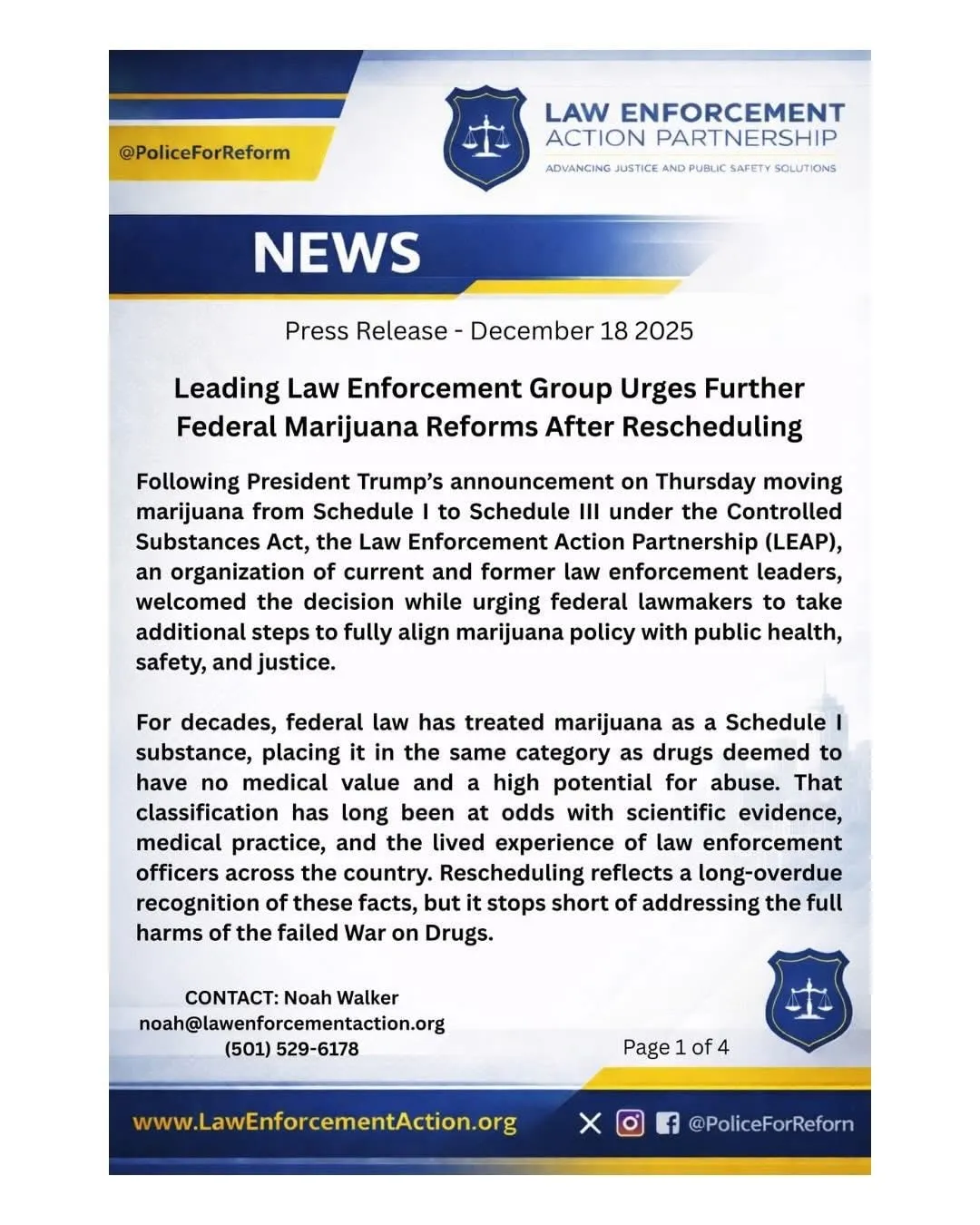
A national organization of current and former law enforcement leaders is warning that today’s federal move to reclassify marijuana does not go nearly far enough—and risks preserving many of the same harms that cannabis reform was supposed to fix.
By CT CannaTimes
A national organization of current and former law enforcement leaders is warning that today’s federal move to reclassify marijuana does not go nearly far enough—and risks preserving many of the same harms that cannabis reform was supposed to fix.
The Law Enforcement Action Partnership (LEAP) released a four-page statement Thursday responding to the administration’s announcement moving marijuana from Schedule I to Schedule III under the federal Controlled Substances Act. While LEAP welcomed the shift as an overdue acknowledgment of reality, the group made clear it views rescheduling as an incomplete and insufficient step.
“Reclassifying marijuana may be a starting point, but it cannot be the end of the conversation,” said Lt. Diane Goldstein (Ret.), Executive Director of LEAP. “If federal policy remains stuck halfway between prohibition and reform, we risk preserving many of the same injustices and inefficiencies that law enforcement has spent decades confronting on the ground.”
Rescheduling Without Decriminalization
Under Schedule III, marijuana would remain illegal at the federal level, leaving state-legal cannabis systems—including Connecticut’s—operating in continued legal uncertainty. LEAP emphasized that rescheduling does not resolve the fundamental conflict between federal law and the reality that most states have legalized marijuana for medical or adult use.
“Moving marijuana to Schedule III may help reduce unnecessary arrests, expand research, and ease barriers to legitimate banking,” the statement notes, “but it does not resolve the fundamental conflict between federal law—under which marijuana remains illegal—and the reality that most states have already legalized medical or adult use.”
Connecticut is among 38 states with regulated medical and/or adult-use cannabis frameworks. LEAP argues that strong regulation and oversight—not prohibition—have proven to be the most effective public-safety tools, allowing police to focus resources on serious and violent crime instead of low-level cannabis enforcement.
Collateral Consequences Remain
LEAP’s statement also highlights what rescheduling fails to address: the ongoing collateral consequences of marijuana criminalization.
According to the group, Schedule III status leaves intact barriers that prevent law enforcement officers, military members, and veterans from accessing state-legal medical marijuana. The organization also notes that first responders experience traumatic stress at significantly higher rates than the general population, yet are denied access to a potential therapeutic option that is legal in many states.
In addition, LEAP stressed that rescheduling offers no automatic relief for people already harmed by marijuana enforcement.
“Rescheduling provides no guarantee of relief for individuals still bearing the weight of past marijuana enforcement,” the statement reads. “The decision does not restore voting rights, create new opportunities for release or resentencing, or provide automatic pardons or expungements for people currently serving federal sentences for marijuana offenses.”
Call for Congress to Act
Rather than stopping at rescheduling, LEAP urged Congress to pursue full descheduling of marijuana and adopt specific reforms such as “second look” sentencing policies, which would allow courts to review and reduce sentences imposed under outdated marijuana laws.
The organization framed its position not as ideological, but grounded in decades of frontline experience.
“As law enforcement leaders, we know that full legalization paired with strong regulation is the best way to combat the illicit drug market, minimize the influence of organized crime, and keep Americans safe,” Goldstein said.
Why It Matters in Connecticut
For Connecticut, LEAP’s warning echoes ongoing concerns raised by advocates, patients, and industry participants: that partial federal fixes can leave states trapped between legalization and enforcement, while doing little to repair past harm.
As federal officials celebrate rescheduling as progress, LEAP’s message is blunt: incremental change without structural reform risks locking in the very injustices reform was meant to end.
CT CannaTimes will continue tracking how federal cannabis policy developments intersect with Connecticut’s medical and adult-use systems, criminal justice outcomes, and public safety priorities.
This story was originally published by Connecticut CannaTimes on Facebook on December 18, 2025 and was migrated to this website on October 16, 2026. The publication date above is the original date.