Inside Connecticut’s Tangled THC Drink Web: Out-of-State Makers, Missing Lab Reports and a $1 Fee Nobody Can Follow
We bought three THC seltzers at Connecticut stores this month and followed every QR code. None led to a lab report for the can in hand. Behind the shelf is a state market built on a separate legal category, a dollar-per-can fee that funds enforcement, a supply chain that runs through other states, and a federal deadline that puts every one of these drinks outside federal hemp law on December 11.
Part of Cannabis Enforcement and the DIA Map · Cannabis Testing, Labs and Product Safety · HB 7181 and Connecticut's Enforcement Laws
Correction (October 19, 2026): An earlier version stated that oHHo’s published reports did not include a formulation corresponding to the photographed 3 mg THC, 5 mg CBD and 5 mg CBG label. An older Kaycha Labs report for batch 5059 includes the same advertised cannabinoid amounts. That report has not been matched to the purchased can and contains an unresolved discrepancy concerning its CBG results. Corrections policy
In October, Connecticut CannaTimes bought three THC seltzers at Connecticut stores: an oHHo Botanicals Blood Orange and Pomegranate, a MUZE Black Cherry and an Ayrloom Lemonade. Each can carries a QR code. Connecticut’s beverage rules say that code should lead to the laboratory’s certificate of analysis.1 We scanned all three and followed every link. None of them opened a lab report for the can we bought.
One can was printed “NOT FOR SALE IN CT.” One listed its origin as Texas. One led, through a third-party short link, to a library of about 1,900 documents, where the only report bearing the can’s recipe code belonged to a production run that had expired months earlier.
Those cans sit in a market that is about to collide with federal law. On October 1, Connecticut let package stores sell THC drinks with up to 5 milligrams per can and let licensed cannabis retailers sell cans with up to 10 milligrams.2,3 On December 11, a change to federal law takes effect that strips hemp status from any finished hemp product holding more than 0.4 milligrams of total THC in its container.4,5 A 3 mg can is seven and a half times that line. A 5 mg can is twelve and a half times it. A 10 mg dispensary can is twenty-five times it.
Connecticut CannaTimes spent weeks reading the enacted public acts, the federal statutes, the written testimony and official hearing transcripts lawmakers relied on, the state’s own licensing and spending data, and the lab reports companies post themselves. This investigation lays out what those records show, and where they run out.
The short version: Connecticut wrote its beverage law so a qualifying THC drink is excluded from the state definition of cannabis on its own terms, not because it is federal hemp.2,6 That gives local drinks a real state-law argument after December 11. It does nothing about federal law. It does not make an out-of-state shipment lawful. And it leaves a long list of questions the Department of Consumer Protection (DCP) and the Attorney General have not publicly answered.
What We Found
- No QR code led to the lab report for the can in hand. All three opened brand-wide pages. The MUZE can’s batch has no posted report, oHHo’s library contains an older report for a similarly labeled formulation that cannot be linked to the can purchased, and Ayrloom’s only matching recipe report covers an earlier production run.
- The federal line moves December 11. Congress rewrote the hemp definition in November 2025 and, in September 2026, pushed most of the change to December 11. One narrow piece, aimed at cannabinoids the plant cannot make naturally, kept a November 12 start.4,5
- Every THC drink sold under Connecticut’s beverage law exceeds the new federal cap, including the 3 mg cans that were the legal maximum in package stores until October.
- Most Connecticut beverage credentials are held out of state. Eight of the 14 active DCP registrations to make THC-infused beverages list addresses in other states or territories.7 Beak & Skiff, the New York family business behind the Ayrloom can we bought, is one of them.8,9
- Local canning is not local THC. Connecticut beverage makers told lawmakers in 2025 and 2026 that their THC had to arrive already diluted from out of state.10,11 A new state ingredient route opens December 1, and it is a state route only.2
- Connecticut’s $1 can fee shows how many drinks are sold, and the money is piling up. Every THC drink sold legally in Connecticut carries a $1 state fee, so the fee totals double as a can count. Liquor wholesalers reported selling about 4 million cans to package stores from July 2024 through June 2026, about $4 million in fees. The first payment DCP reported to lawmakers, $659,492, matches the wholesalers’ reported can count exactly. The fees go into a DCP enforcement account that had roughly $11 million unspent by mid-2026. Lawmakers created the fee partly to pay the Attorney General’s office to enforce cannabis and hemp laws, but state spending records show no visible payment to that office for that work.12,13,14,15,16
- Some brands test for heavy metals and pesticides. Some do not. The only report Ayrloom posts for its lemonade recipe includes a full contaminant panel: heavy metals, pesticides, microbes, mycotoxins and residual solvents. The MUZE and oHHo reports we followed test only cannabinoids, plus solvents in two cases. None of them includes heavy metals or pesticides.9,17,18,19
- Connecticut already bans chemically converted THC. State law treats cannabinoids made by a chemical process as synthetic cannabinoids, lists them in Schedule I and bars hemp products from containing them. Since October 1, beverage makers may use only hemp oil or THC extracted directly from raw hemp.6,20,21
Three Cans, Three Lab Trails
Each can was photographed front, back and bottom. The QR codes were decoded from the photographs and followed to their destinations. Every lab report described below was downloaded from the brand’s own website.
MUZE Black Cherry: made in Bloomfield, marked not for sale in Connecticut
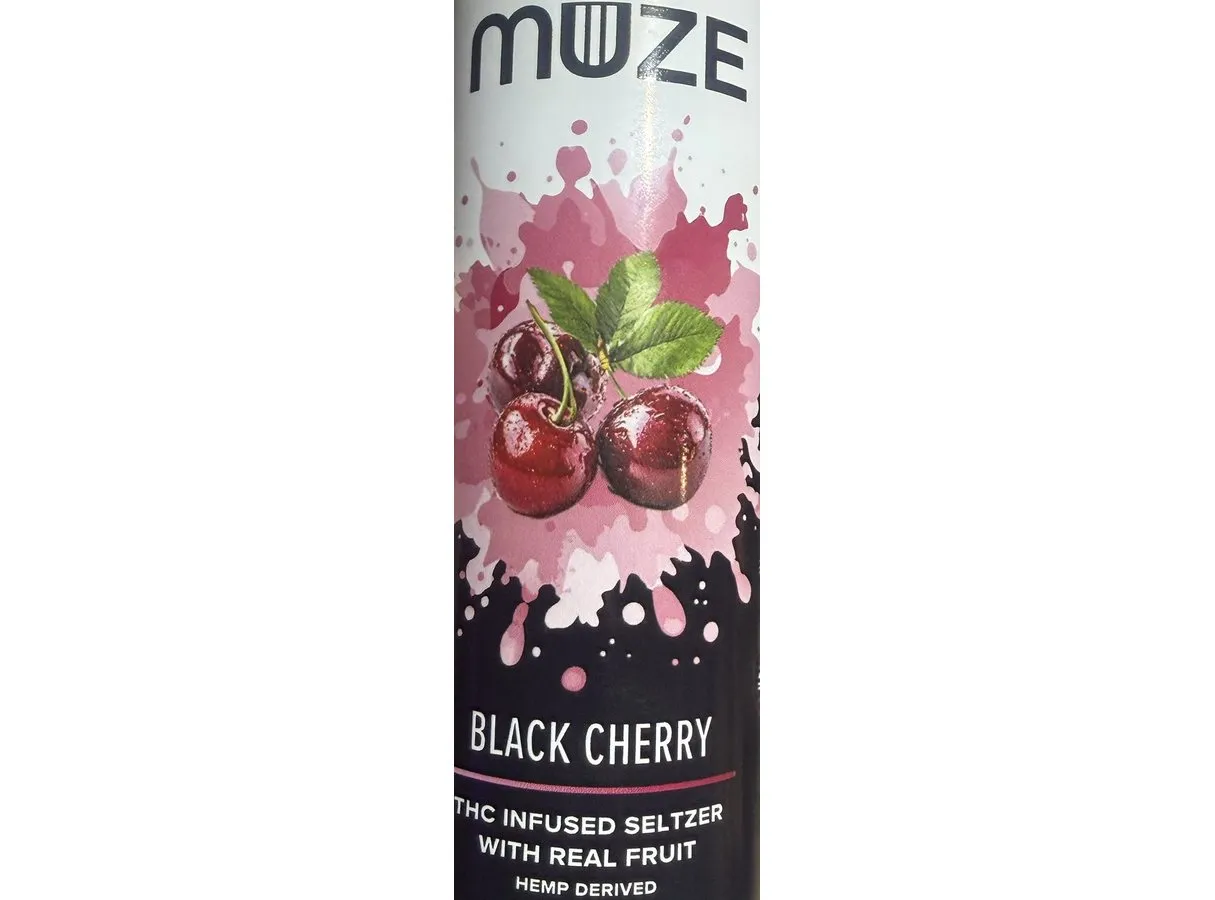
The MUZE Black Cherry can purchased at a Connecticut store. Photo: Connecticut CannaTimes.
The MUZE can advertises 5 mg of hemp-derived THC and 15 mg of CBG and says one can holds five servings. It says it was “manufactured by THCDrinkCo for MUZE” at 16 Tobey Road in Bloomfield, the address of Thomas Hooker Brewing. Its ingredient list includes gum acacia and MCT coconut oil, the building blocks of a beverage emulsion.
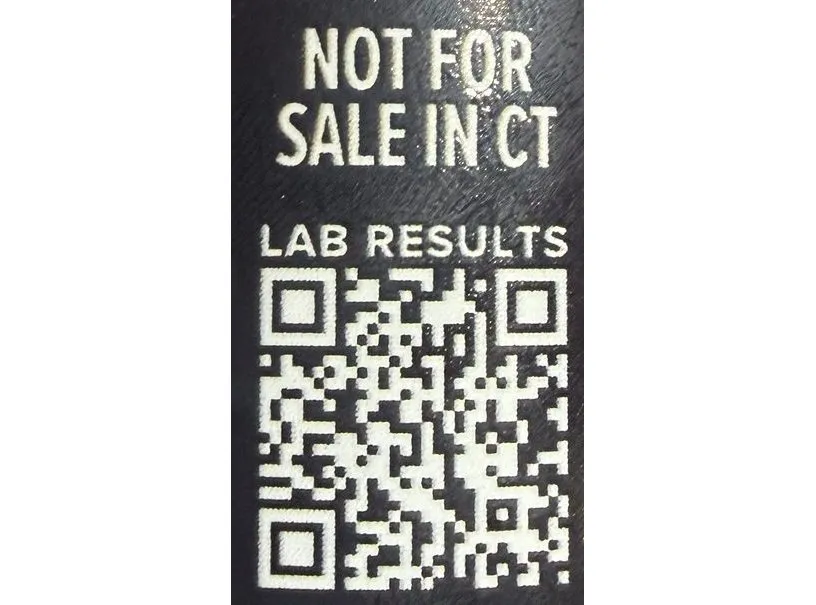
The MUZE can, bought in Connecticut, is printed “NOT FOR SALE IN CT” directly above its lab-results code. Photo: Connecticut CannaTimes.
Directly above the QR code, labeled “LAB RESULTS,” the can is printed “NOT FOR SALE IN CT.” The bottom of the can explains when it was made: “GYLE#212, PKG 9/30/26, EXP 9/30/27.” Batch 212 was packaged September 30, 2026, the last day Connecticut’s package-store limit stood at 3 mg. A 5 mg can packaged that day could be sold legally only outside the state, which is consistent with the label. The 5 mg limit took effect the next morning.2 Since 2026, Connecticut has also allowed beverage makers to produce stronger drinks for out-of-state sale under a separate endorsement, labeled not for sale in Connecticut.22 Whether a can packaged for another state may now be sold here is a question DCP has not publicly answered.
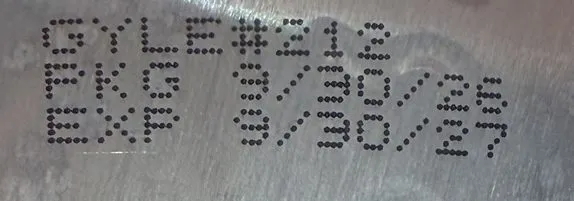
The MUZE can’s batch code: batch 212, packaged Sept. 30, 2026. Photo: Connecticut CannaTimes.
The QR code opens MUZE’s lab-results page, which lists about 70 reports across six flavors.23 There is no report for batch 212. The highest batch number listed for any flavor is 211, a 50 mg Black Cherry batch, ten times Connecticut’s highest beverage limit. The page lists 22 Black Cherry batches at strengths from 2 mg to 50 mg.
The two most recent 5 mg Black Cherry reports show why a batch-specific report matters. Batch 173, tested by Analytics Labs CT in New Britain and completed October 13, 2025, found 4.82 mg of THC and 14.69 mg of CBG per can.17 Batch 195, tested at Analytics Labs in Holyoke, Massachusetts, and completed February 24, 2026, found 3.83 mg of THC, about 23 percent below the label.18 That report states the sample was “Tested for Rhode Island License #LICLCD02” and that its pass limits follow Massachusetts cannabis regulations. Connecticut allows a 10 percent variance for qualifying beverages.2 Neither of those batches is the can we bought.
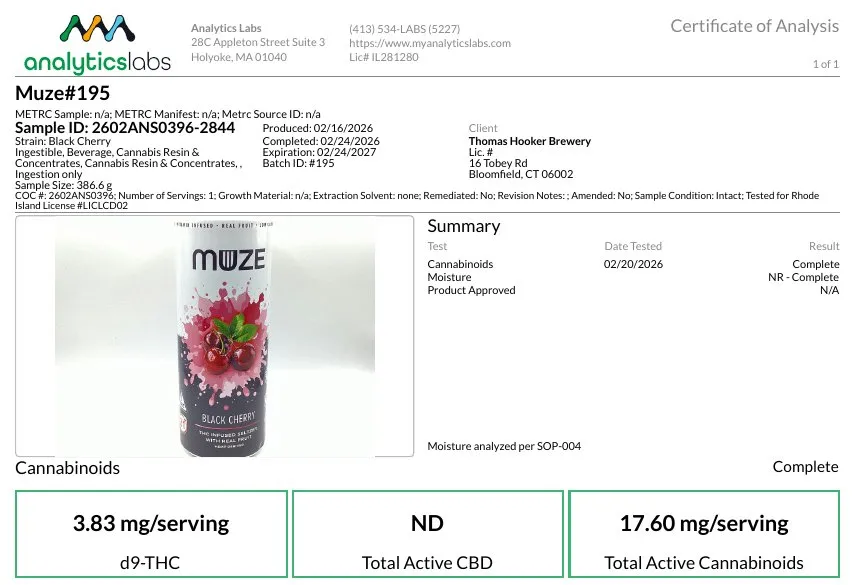
Excerpt of the posted certificate for MUZE Black Cherry batch 195, a different batch from the one purchased: 3.83 mg of THC against a 5 mg label, “Tested for Rhode Island License.” Source: MUZE lab-results page.
Both reports cover cannabinoids. The Connecticut report adds residual solvents, all not detected. Neither includes heavy metals, pesticides, microbes or mycotoxins. Both treat the can as one serving; the can says five.
oHHo Blood Orange and Pomegranate: “Origin: Texas”
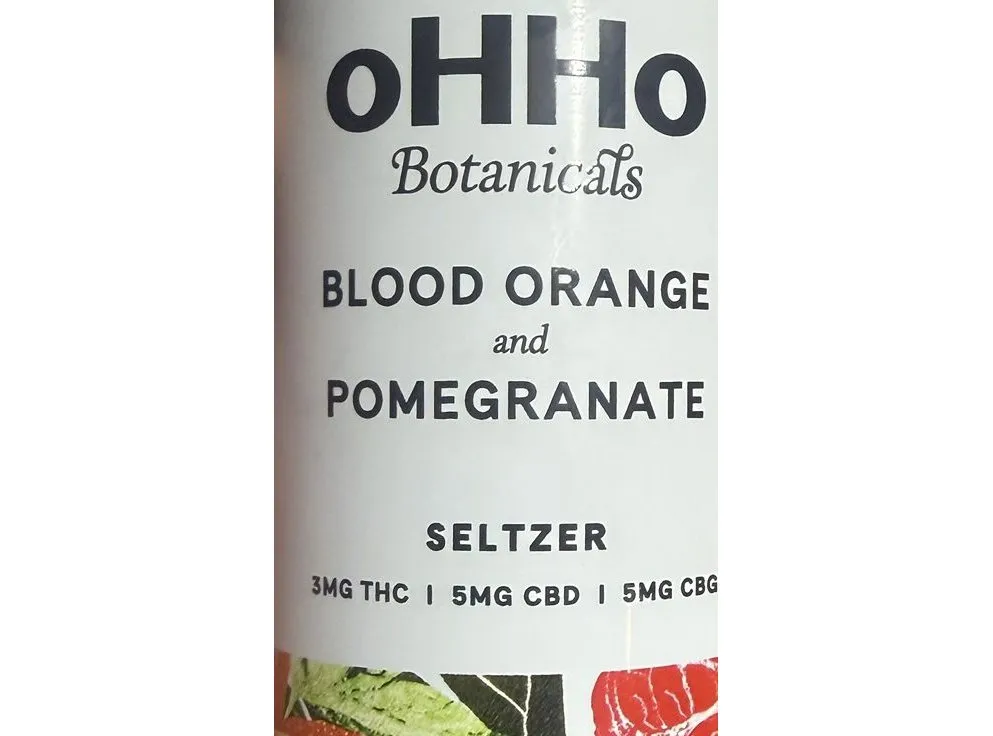
The oHHo can purchased in Connecticut lists 3 mg THC, 5 mg CBD and 5 mg CBG. Photo: Connecticut CannaTimes.
The oHHo can lists 3 mg of THC, 5 mg of CBD and 5 mg of CBG per can, in two servings. Its back panel reads “Origin: Texas, USA” and “Manufactured for: oHHo Botanicals, 34 Village Green, 10506 Bedford NY.” Its side warning says the product is federally legal with less than 0.3 percent THC. The ingredient list names carbonated water, agave syrup, natural flavors and citric acid, with no emulsifier or carrier oil listed. The can bottom carries a smeared inkjet code that cannot be read reliably, and no expiration date.
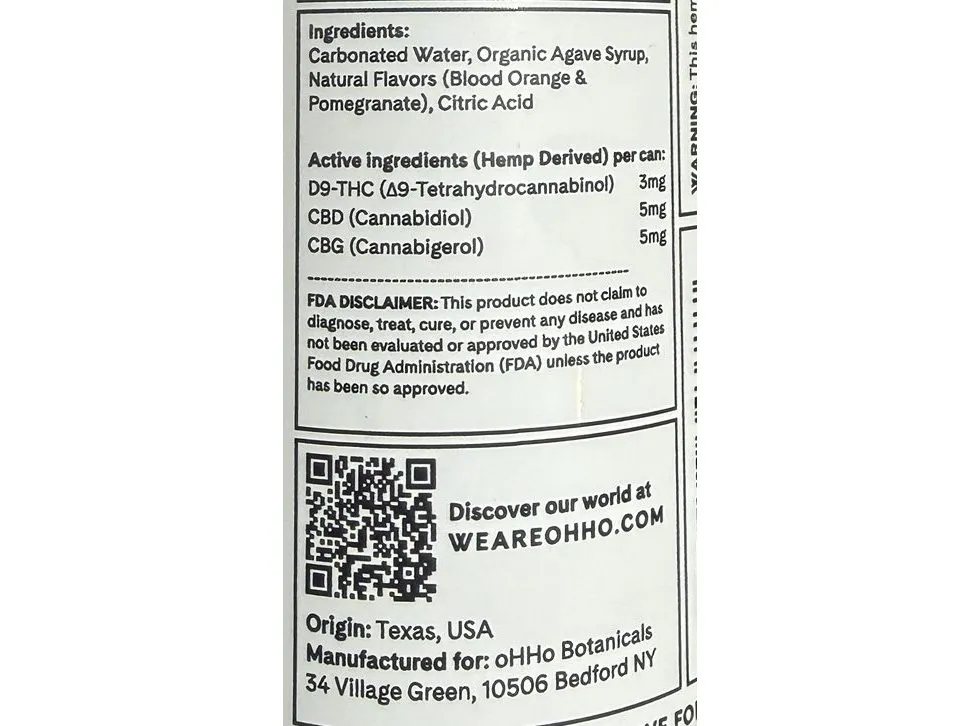
The oHHo can’s back panel: “Origin: Texas, USA.” Photo: Connecticut CannaTimes.
The QR code, labeled as a brand link, opens oHHo’s national certificate library: about 30 Blood Orange and Pomegranate reports and roughly 250 more for other products.24 The national library does contain an older Blood Orange and Pomegranate certificate for batch 5059, tested by Kaycha Labs in Denver and completed March 19, 2025. The report includes a product photograph labeled 3 mg THC, 5 mg CBD and 5 mg CBG, the same advertised combination printed on the can purchased for this investigation. Kaycha reported 2.84 mg of THC and 4.97 mg of CBD per container. A comment on the second page lists 4.97 mg of CBG per can, although the first-page cannabinoid analysis reports CBG below its stated threshold. That discrepancy is not explained in the certificate. The certificate is stamped “PASSED,” but its pesticide, heavy metal, microbial, mycotoxin and residual solvent panels are each marked “NOT TESTED.” The report expired in March 2026, and the purchased can’s unreadable lot marking prevents a confirmed batch match.24,92 oHHo keeps a separate Connecticut page that says its Connecticut cans are “Made by Thomas Hooker Brewery” in Bloomfield and lists two Blood Orange and Pomegranate 3 mg reports.25 The newer one, batch 025, completed June 8, 2026 by Analytics Labs CT, found 2.59 mg of THC, 4.60 mg of CBD and no detectable CBG.19 That is a different formula from the can we bought, which lists 5 mg of CBG. Without a legible lot code, there is no way to match this can to any report.
Ayrloom Lemonade: the right recipe, the wrong year
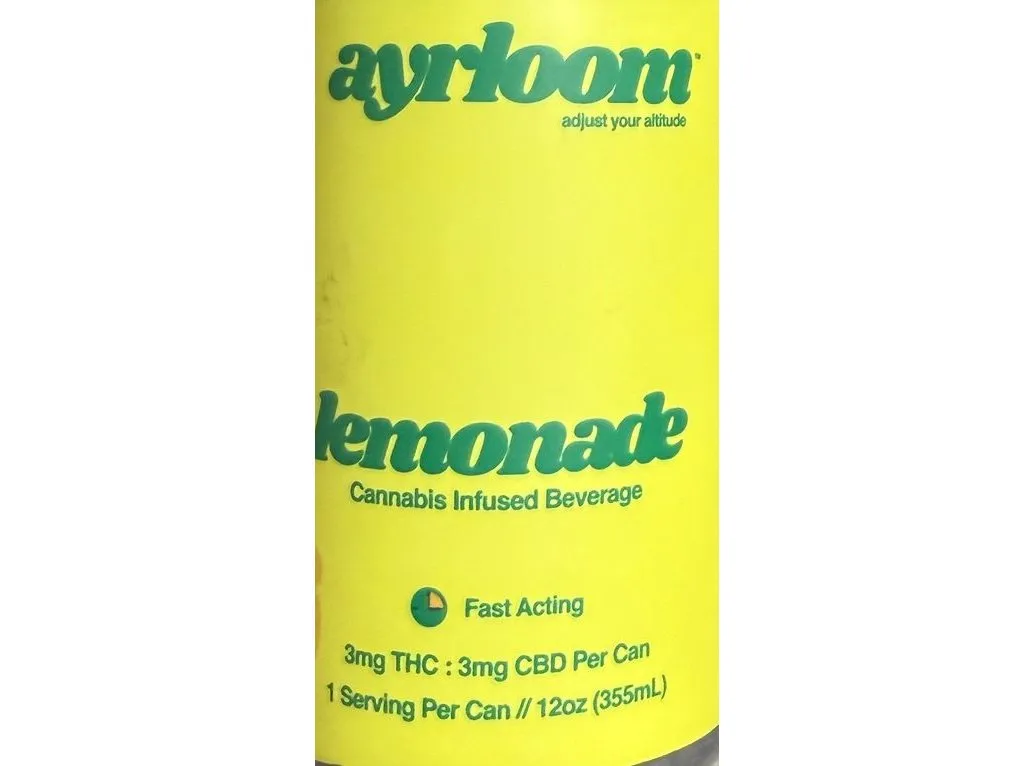
The Ayrloom Lemonade can purchased in Connecticut. Photo: Connecticut CannaTimes.
The Ayrloom can lists 3 mg of THC and 3 mg of CBD. It says it was “Produced for Ayrloom, OCM-HMPE-23-00058, Lafayette, NY 13084,” a New York hemp license number, and “NY Family Owned & Grown Since 1911.” The front says “Fast Acting.” The back warns that effects “may be delayed by 4 or more hours.” A sticker on the bottom reads “Exp/Use By: 05/20/27, Lot: 052027-THC008, 14425.”
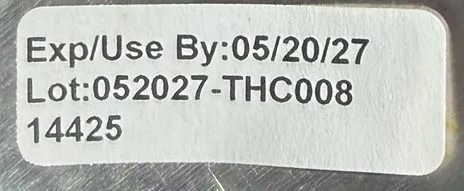
The Ayrloom can’s lot sticker. Photo: Connecticut CannaTimes.
Its QR code, labeled “Scan here for potency information,” decodes to a third-party short link that redirects to Ayrloom’s general lab-tests page, not a report for this lot. Ayrloom’s own home page says its codes are batch-specific.8,26 The lab-tests page draws on a table of about 1,900 documents covering every Ayrloom product, including 32 lemonade reports.27 Only one carries the recipe code THC008. It expired May 20, 2026. The can expires May 20, 2027.
The can’s lot number appears to combine its expiration date with the recipe code. On that pattern, the posted report belongs to a run made a year earlier. That report, from Trichome Analytical in Mount Laurel, New Jersey, lists the client as Beak & Skiff Research under the same New York license printed on the can. It found 3.06 mg of THC and 3.08 mg of CBD per can and, unlike the MUZE and oHHo reports, includes a full contaminant panel: residual solvents, microbes, mycotoxins, pesticides and heavy metals, all passing under New York hemp limits.9 It documents the recipe, not the can on the shelf.
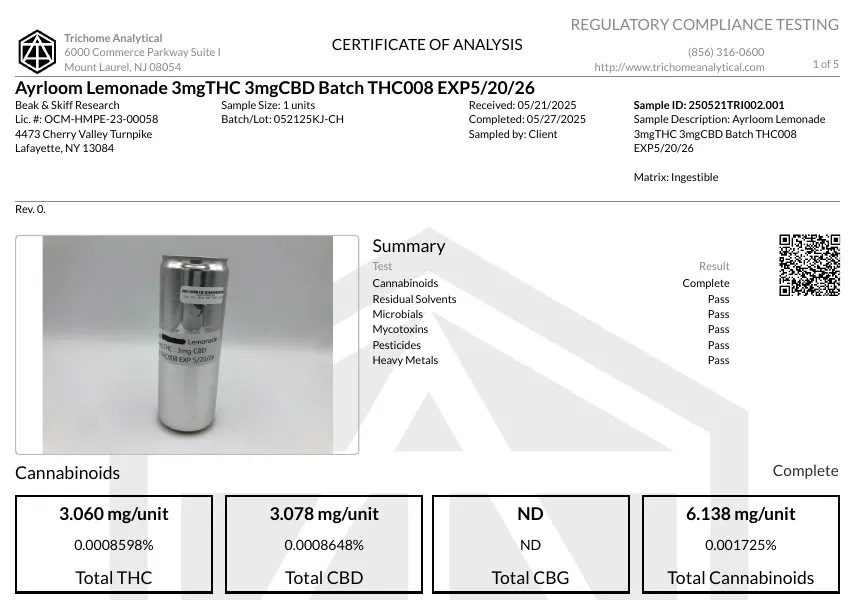
The only posted Ayrloom report bearing the recipe code THC008. It is dated for a can expiring May 20, 2026; the can we bought expires May 20, 2027. Source: Ayrloom lab-tests page.
Beak & Skiff Apple Farms in La Fayette, New York, holds one of the eight out-of-state Connecticut registrations to make THC-infused beverages.7
What the three cans show
Taken together, the cans show the gap between the law’s promise and what a shopper can actually check. DCP’s guidance says each can must carry a code or web address “linked to the laboratory’s certificate of analysis.”1 In all three cases, the code opened a brand-wide page instead. Whether a link to a library of hundreds of reports satisfies that rule, and whether finished-beverage reports must include contaminant testing, are questions DCP has not publicly answered. Two of the three cans named origins outside Connecticut. The third was made in Connecticut for sale somewhere else.
The Calendar That Matters
Four dates control this story, and each changes something different. Older coverage that names a single November deadline is out of date.
October 1, 2026 is already behind us. On that date Connecticut raised the limit for qualifying drinks to 5 mg per container in package stores and 10 mg in licensed cannabis retail, and new packaging, testing and manufacturer-retail rules took effect.2,3 The same day, a rule from Public Act 26-100 took effect limiting beverage makers to hemp oil or THC extracted directly from raw hemp.21 That is a state expansion paired with a tighter ingredient rule.
November 12, 2026 is when the federal exclusion for products containing cannabinoids the cannabis plant cannot naturally produce takes effect.4,5 It is narrower than a ban on all synthetics, and which products it reaches depends on chemistry and process.
December 1, 2026 opens Connecticut’s new route for licensed hemp manufacturers to make high-THC “intermediate hemp derivatives” and sell them to designated cannabis producers and manufacturers and to infused-beverage manufacturers. Retailers are not on the buyer list.2,3 It is a state supply pathway with no federal protection.
December 11, 2026 brings the rest of the federal rewrite: total THC including THCA, the 0.4 mg per-container cap on finished products, the bar on naturally occurring cannabinoids made outside the plant, and the new seed rule.4,5 On that date, ordinary 3, 5 and 10 mg hemp drinks fall outside the federal hemp exemption.
It is tempting to read the ten days between December 1 and December 11 as a deliberate state safe harbor. The record does not support that. Gov. Ned Lamont signed Public Act 26-8 on May 20, 2026, when the federal date was still November 12, before December 1.2 Congress did not move most of the federal change to December 11 until September 2, in a stopgap spending law.5,28 The gap is a coincidence of timing, not evidence of a plan.
What the New Federal Rule Actually Measures
The amended federal definition keeps a 0.3 percent concentration test but counts total THC, expressly including THCA. Then it adds a second, separate test for finished products. A “final hemp-derived cannabinoid product” is no longer hemp if it holds more than 0.4 milligrams, per container, of total THC combined with other cannabinoids that federal health officials find have, or are marketed as having, similar effects.4
The container is the innermost package that touches the product: the can, the bottle, the gummy bag. A four-pack does not get four allowances, and a carton does not get one at all. The rule is not a 0.4 mg cap on CBD, and it does not give each form of THC its own allowance.4,29
Passing one test does not answer the other. The Ayrloom report shows why. It lists the can’s 3.06 mg of THC as 0.00086 percent of the drink’s weight, because a can is mostly water.9 By the old percentage test alone, the drink looks nowhere near the 0.3 percent line. Under the new container test, it is more than seven times over the cap.
The law also told federal health officials to publish lists of covered cannabinoids and clarify the container term, about 90 days after enactment. As of a September 28, 2026 Congressional Research Service update, the Food and Drug Administration had not published them.29 That leaves some minor-cannabinoid questions open. It does not leave the THC question open: a 3 mg can is over 0.4 mg no matter what the lists say.
How Connecticut Defines the Same Can
Connecticut does not use one interchangeable definition of hemp. It uses several, and the beverage sits in its own lane.
Ordinary hemp is excluded from Connecticut’s definition of cannabis in Section 21a-240(29), as replaced this year by Public Act 26-100.6,21 That exclusion is tied to hemp as defined in federal law, so when the federal definition narrows, it narrows with it.
Infused beverages are excluded in a separate subparagraph of the same definition.6 That exclusion is not written as a subset of the hemp exclusion. The beverage itself is defined in Section 21a-425, as amended by Public Act 26-8, by dose, form and sales channel, and the text reviewed contains no condition that the finished can remain federal hemp.2,30
That separate exclusion is the strongest argument that a compliant Connecticut-made can stays lawful under state law after December 11. It is a real argument. It is not the end of the analysis. The drug-law definition of cannabis-type substances in Section 21a-240(7) has its own federal-hemp exclusion but does not repeat the beverage exclusion.6 Section 21a-243 gives the state a way to follow new federal controlled-drug designations.31 Neither was written with this collision in mind, and no public DCP or Attorney General interpretation reconciling them was found.
Lawmakers did build in a warning light. Section 21a-425a requires DCP, working with the Attorney General, to report to the legislature when a federal farm-bill change conflicts with the beverage statute. The trigger runs from a U.S. Department of Agriculture announcement, and the statute names the 2018 farm bill, while the new federal language amends a 1946 marketing law.2,32 No responsive report or post-December beverage guidance was found in public sources.
What ‘Made in Connecticut’ Cannot Fix
Federal drug law does not require that a product cross a state line. The U.S. Supreme Court held in Gonzales v. Raich that Congress can reach purely local cannabis activity even where a state authorizes it.33 Moving canning into Connecticut can change the state supply route. It cannot restore a federal hemp exemption the product no longer has.
There is an older federal problem too. The FDA has long said that adding THC or CBD to food sold in interstate commerce violates the federal Food, Drug, and Cosmetic Act.34 Federal hemp status was never federal food approval. December adds controlled-substance exposure on top of a food-law position that already existed.
Connecticut’s own beverage statute says it does not authorize interstate transportation that violates federal law.2 After December 11, that sentence points at every truck carrying an out-of-state 3 mg four-pack into the state.
Where the Drinks Come From
A brand’s headquarters and a retailer’s “state of origin” tag do not reliably say where a drink was canned. The most useful evidence pairs a Connecticut-specific listing with the maker’s own production statement.
Total Wine advertises Connecticut versions, marked “CT,” of several national brands. Its Cycling Frog Wild Cherry CT lists 3 mg of THC and 6 mg of CBD per 12-ounce can and gives Oregon as the state of origin; at its 2022 launch, Cycling Frog said all its products are made in Oregon from Oregon hemp.35,36 Its Oliphant Decay Blueberry Lemonade CT, at 3 mg, says it comes from Somerset, Wisconsin.37 Its WYNK Tangerine CT lists 3 mg of THC in a one-to-one THC and CBD formula.38 These are catalog listings, not a shelf audit, and they were not matched to shipping records.
DCP’s own licensing roster tells the same story at scale. On October 19, the state’s eLicense system listed 14 active registrations to manufacture THC-infused beverages. Eight list addresses outside Connecticut. They are Beak & Skiff Apple Farms in La Fayette, New York; Metabrand LLC in Edison, New Jersey; Canvas 340 LLC in Charlotte Amalie, U.S. Virgin Islands; Hop the Wave Brewing in Portland, Maine; Northwest Natural Goods in Clackamas, Oregon; The Love Lab in Hatfield, Pennsylvania; Riverside Collective in Chattanooga, Tennessee; and Oliphant Brewing in Somerset, Wisconsin.7
The six in Connecticut are Black Hog Brewing in Oxford, Connecticut Valley Brewing in South Windsor, Float House in Windsor, Sono 1420 Artisan Distillers in Norwalk, Thomas Hooker Brewing in Bloomfield and Two Roads Brewing in Stratford.7 Three of the out-of-state registrations expire in October, November or December, so DCP will be processing renewals for makers whose products will be outside federal hemp. Thomas Hooker’s registration shows an effective date of November 27, 2026, a date that has not yet arrived.7
A Connecticut credential is permission to take part in this market, not proof the factory is here. DCP distinguishes the company that actually manufactures a beverage, which needs a $5,000 license, from a company that merely owns the brand, which does not.39 Roster addresses are registration addresses, and one registrant can supply several brands.
Local makers exist. Hi! People markets “CT Made” fruit seltzers at 3 mg of THC and 3 mg of CBG.40 MUZE offers 3, 5 and 10 mg versions of its lemon drink with 15 mg of CBG,41 and its founder, who also founded Thomas Hooker, has written that MUZE makes its emulsions in-house.42 A Connecticut food publication reported in 2026 that MUZE uses hemp from farms in Oregon.43 Thomas Hooker advertises co-packing of THC, CBD and CBG beverages using its own emulsions.44 None of those statements says where the THC itself was grown, extracted or diluted. oHHo shows how separate those facts are: its product page advertises a 5 mg THC, 5 mg CBD and 5 mg CBG standard dose,45 its Connecticut page names Thomas Hooker as the maker of 3 mg Connecticut cans,25 and the oHHo can we bought says Texas.
Where the THC Comes From
A beverage company does not need to grow hemp or run an extraction plant. It needs a THC ingredient, and that ingredient is the least visible and most legally consequential part of the chain.
How hemp THC is made, in general, is laid out by the industry itself. Vertosa, a California company that supplies cannabinoid ingredients to drink makers nationally, has published explainers on the process. Nothing in the public record connects Vertosa to any drink or company named in this story; its descriptions are used here only as general background. Vertosa writes that hemp-derived delta-9 THC can be drawn from the material left over after CBD is isolated, a “mother liquor” of roughly 5 to 20 percent THC that is enriched above 60 to 70 percent and distilled above 85 percent.46 It also describes a second route used in the industry: making delta-9 by chemically converting CBD.47 A potency number on a finished can usually cannot say which route the THC took.
Each stage of the chain has its own record and its own legal question. The crop has a producer license and a harvest test, which show whether the raw plant was hemp. The extract or distillate has an ingredient certificate and process records, which show its THC level and whether the THC was extracted or converted. The shipment has invoices and receiving records, which show what crossed a state line, and whether it was concentrate or diluted emulsion. The local plant needs authority to hold and process the material. Only the last stage, the finished can, is covered by the lab report a shopper sees.
A low-potency can does not retroactively legalize an earlier shipment of concentrated THC. The federal Drug Enforcement Administration said in a 2020 rule that a cannabis derivative must itself meet the delta-9 limit to count as hemp; coming from a compliant plant is not enough.48 That problem predates December.
Connecticut already bans converted THC
Connecticut does not treat chemically converted THC as hemp. State law defines a “synthetic cannabinoid” as any substance “converted, by a chemical process, to create a cannabinoid or cannabinoid-like substance” that acts on the body’s cannabinoid receptors, and names HHC as an example.6 The law requires DCP to list synthetic cannabinoids in Schedule I, the most restrictive category of controlled substances,6 and bars hemp products sold in the state from containing any.20 A narrower category, “manufactured cannabinoids,” covers conversions using light, heat, decarboxylation or a process DCP approves and posts online. Those count as cannabis, not hemp, and belong only in the licensed cannabis system.6
Delta-9 THC can be pulled from the plant, or it can be made from CBD. Vertosa, the California ingredient supplier whose general explainers are described above and which is not connected to any product in this story, describes the second route as “chemical conversion from CBD through an acid catalysis reaction.”47 That is not a natural THC source. It is THC created by a chemical reaction from a different cannabinoid. Unless DCP has approved and posted such a process, converted delta-9 appears to fall within Connecticut’s definition of a synthetic cannabinoid. On that reading, it would not be hemp under state law, and it could not lawfully go into a hemp product or a drink sold here. Connecticut CannaTimes found no DCP posting approving such a process. No brand named in this story publicly says it uses converted THC. Several describe their THC as hemp-derived or naturally occurring, and Connecticut CannaTimes found no public statement from any of them describing a conversion process.49
For drinks, lawmakers closed the ingredient door this year. Since October 1, 2026, a beverage maker may use only “hemp oil” or an “intermediate hemp derivative” to make a drink sold in Connecticut,21 and an intermediate hemp derivative must be extracted “directly and exclusively from raw hemp plant material” by listed methods such as heat, ethanol, carbon dioxide or solventless extraction.21 Converted THC does not fit that definition. “Hemp oil” is not separately defined in the statutes reviewed. The beverage law itself never uses the word “synthetic,” and the clause that keeps qualifying drinks out of the definition of marijuana does not reach the separate Schedule I listing for synthetic cannabinoids. No public enforcement action applying that listing to a beverage was found.
None of this says what is in a particular can. A potency result cannot show whether THC was extracted or converted, and none of the lab reports we followed for the three cans addresses the question. Whether DCP verifies where beverage THC comes from, and how, is a question the agency has not publicly answered.
Connecticut makers said the dilution happened out of state
In written testimony for a March 19, 2025 General Law Committee hearing, Gordon Whelpley, chief executive of Float House, a hemp food and beverage maker in Windsor, wrote that THC ingredients “must arrive at our facilities already diluted below 0.3% THC,” and that diluting outside Connecticut was the only workable route. He asked lawmakers to let manufacturers dilute concentrated ingredients on their own licensed premises.10 That is a company’s account, not an agency finding, but it is far stronger evidence than an inference from a can, and it predates the federal amendment by nearly eight months.
The submission attached a material-handling procedure the witness described as DCP-approved, covering distillate and water-soluble emulsion, incoming tests and what to do with a batch over the limit. No separate DCP approval letter was included.10 The scope of any approval would have to come from DCP’s own file.
On March 4, 2026, Whelpley submitted a combined position for six Connecticut beverage makers: Float House, Thomas Hooker, Two Roads, Connecticut Valley, Black Hog and Sono 1420. It said only two Connecticut extractors existed and neither operated at beverage scale, and it asked for authority to bring in compliant out-of-state ingredients and to handle material above 0.3 percent.11 Two months later, Whelpley put the industry’s goal plainly in a trade interview: “We need to be able to legally stockpile.”50
At the same March 4 hearing, Paul Travaglino, founder of Enlightened Foods, a Norwalk cannabis food-and-beverage manufacturer, testified for the Connecticut Canna Food and Beverage Alliance. The official transcript records him describing DCP’s position as being that hemp manufacturers “can’t hold any extract.” He said he had circulated an explainer on the federal changes that “was about eight pages,” and that “Senator Maroney and Senator Osten asked DCP to draft something, and that was the extractor language.”51 In his account, the extractor provision began as language legislators asked the agency to write.
His interest is a matter of public record. Enlightened Foods holds an active Connecticut cannabis food-and-beverage manufacturer license, and food-and-beverage manufacturers are among the buyers the new ingredient route allows.2,7 In 2024 testimony he identified himself as a member of the same alliance and pressed for manufacturing-license flexibility and access to fresh biomass.52 Advocating for one’s own license class is not wrongdoing. It is context readers should have.
What the legislature built instead
The final law did not adopt the industry’s proposed wording. Section 99 of Public Act 26-8 defines an “intermediate hemp derivative” as an oil or concentrate above 0.3 percent total THC extracted directly from raw hemp. Section 100 lets licensed hemp manufacturers, beginning December 1, sell those derivatives to cannabis producers, cultivators, micro-cultivators, product manufacturers and food-and-beverage manufacturers and, in a separate clause, to infused-beverage manufacturers. Cannabis retailers are not on the list. The beverage clause requires an independent lab certificate, invoices and transport records.2,3
During the April 30, 2026 Senate debate, Sen. James Maroney said that before the change, “we weren’t allowed to sell Connecticut hemp-derived THC” for use in infused beverages. Sen. Paul Cicarella said the fix meant the people making seltzers in Connecticut would not have to go out of state for it.53 That supports a deliberate repair of local supply. It does not support claims that the law moved every intoxicating product into dispensaries; package stores and maker-premises sales remain.
Three wrinkles in the new route remain unexplained. The Office of Legislative Research summary says derivatives received by beverage makers are deemed cannabis on receipt, but the enacted text puts that sentence in the subsection for cannabis establishments, and the separate beverage-maker subsection does not repeat it.2,3 The section describes the derivatives as being for use in a “manufacturer hemp product,” a defined term that excludes infused beverages, while expressly naming beverage makers as buyers.2,20 And the ingredient route points to regulations under one statute while the finished-beverage rule recognizes DCP policies and approved standards, so the precise testing authority for the ingredient has not been publicly identified.2
Inside the Emulsion
THC is an oil. Seltzer is mostly water. The bridge between them is an emulsion: tiny droplets of cannabinoid-bearing oil kept suspended by a stabilizer. Saucy Brew Works in Cleveland, which makes a 5 mg THC and 10 mg CBD drink called BLOOM, publishes the components of its hemp ingredient: distilled water, gum acacia, hemp-derived cannabinoids, medium-chain triglycerides, citric acid and sodium benzoate.54 The MUZE can we bought lists the same core pieces on its own label, gum acacia and MCT coconut oil alongside the THC and CBG extract. Other formulators use different stabilizers, such as quillaja.55
In such a formula the water carries the drink, gum acacia keeps the oil droplets from merging, MCT oil carries the fat-soluble cannabinoids, citric acid controls acidity and sodium benzoate preserves it.56 A label does not say how much of each is used, where the cannabinoids came from, or how the drink holds up over its shelf life. Not every can lists those parts: the oHHo and Ayrloom cans name only a cannabinoid or “hemp extract” without a separate emulsifier or carrier oil.
Adding water does not solve the legal problem. Hemp’s 0.3 percent test is measured on a dry-weight basis, which excludes moisture.57 Picture a sample with 1 mg of THC, 99 mg of other solids and 900 mg of water. It is 0.1 percent THC by wet weight and 1 percent by dry weight. Add another 1,000 mg of water and the wet-weight figure halves. The dry-weight ratio stays at 1 percent, and the milligrams in the can do not change. A low percentage on a beverage certificate cannot wave away either the dry-weight test applied to a concentrated ingredient or the new whole-container cap.
Familiar ingredients are not an approved drink. Gum acacia, citric acid and sodium benzoate each have federal food-use regulations with conditions attached.56 None of that is federal approval of a THC beverage, and the FDA’s position on added THC and CBD in interstate food still stands.34 The FDA has also explained that small amounts of benzene can form in some drinks that combine benzoate with ascorbic acid, with heat and light as factors.58 The Saucy ingredient lists citric acid, not ascorbic acid. This investigation found no evidence of benzene in any named product; the point is that full formulas matter before anyone makes safety claims in either direction.
Testing and Certificates of Analysis
As amended by Public Act 26-8, Connecticut requires representative samples of each lot of infused beverage, in final form, to be tested before sale, by a Connecticut cannabis testing laboratory or a similarly qualified laboratory located in and licensed by another state. A beverage may not be sold unless it meets applicable cannabis testing standards or alternative standards DCP approves and publishes, and the reported THC may vary by up to 10 percent either way for measurement uncertainty.2,3 The out-of-state lab option is new. The 10 percent is for measurement error. It is not permission to formulate a 5.5 mg can, and it does nothing to the federal 0.4 mg cap.
The testing rules have never become permanent regulations
Connecticut’s cannabis testing standards live in temporary “policies and procedures,” not adopted regulations. DCP’s current version took effect November 12, 2024, including its testing sections and final-package testing guidance.59 DCP’s proposed permanent adult-use regulations, which include the testing section, were rejected without prejudice by the legislature’s Regulation Review Committee on April 22 and again on May 27, 2025. A third submission was scheduled for June, but DCP withdrew the proposal permanently on June 11, 2025, according to the state’s eRegulations record, which gives no reason.60
Rather than wait for new regulations, lawmakers used Public Act 26-8 to keep the temporary policies in force until final regulations are adopted or July 1, 2028, whichever comes first.2,3 DCP confirmed that timeline in writing in response to a Connecticut CannaTimes inquiry. No 2026 notice of draft revised testing policies appears on DCP’s notices page.61
Where a shopper can find the lab report
Under DCP’s labeling guidance, each can must carry a scannable code, web address or QR code linked to its laboratory certificate.1 That is a product-by-product disclosure, not a central index. Checking it takes the physical can, the link, the report it opens, the lot number on both, the lab name and the full results. As the three cans we bought show, a link that opens a brand library, a different batch or an older run does not answer what is in the can in hand.
Connecticut publishes a Cannabis Product Registry on its open-data portal, with a lab-analysis link field for registered cannabis products.62 It publishes a separate THC Beverage Sales dataset that tracks wholesaler can counts for the $1 fee.12 Neither is a searchable index of beverage lab results. A full query of the registry on October 19 returned 36,568 records; not one is categorized as a beverage, and the closest product type is “Liquid Marijuana Infused Edible.”63 That makes legal sense, since qualifying beverages are excluded from the cannabis definition the registry is built around. It still leaves consumers with no single place to compare a 10 mg drink’s contaminant results with a 10 mg edible sold at the same counter.
What a certificate shows, and what it does not
A certificate identifies a sample, a lot and a date, and reports the finished dose per container. It does not say which ingredient lots went into the drink, or how strong the shipped concentrate was. A dry-weight percentage reflects the lab’s stated basis, not the moisture method or the measurement uncertainty behind it. Passing results cover only the panels actually run. Of the reports we followed, only Ayrloom’s ran contaminant panels.9,17,18,19 Some Connecticut makers post their reports publicly; Float House’s library held reports dated November 2025 through May 2026 when checked.64
Emulsions are also harder to test than flower. An Agilent application note explains that carrier oils and emulsifiers complicate extracting and measuring cannabinoids in beverages, and that labs must validate recovery in the specific drink.65 That is a method point, not evidence that any lab got a number wrong.
A certificate for an upstream concentrate describes the concentrate. It cannot show that nothing was introduced later by water, carriers, equipment or packaging. Which panel applies to which finished product, and whether any upstream result can substitute for final testing, depends on the DCP standard in force for that lot, and those standards have not been gathered in one public place.
The blending question
DCP’s 2024 hemp manufacturer testing policy, which states an effective date of February 19, 2024 (a DCP knowledge-base article gives February 22), describes destroying a batch that fails a preliminary delta-9 test or combining it with another tested batch, with notice to DCP within five business days.66 The statute in force in 2025 expressly allowed DCP to approve combining batches of raw hemp plant material.20 The procedure attached to the 2025 Float House testimony applies that blending framework to distillate and water-soluble emulsion.10 Whether liquid ingredients fit a provision written for plant material, and under what written approval, is a question for DCP’s own records. The records reviewed do not show that any blending was unlawful.
One line should never blur. Lowering an excess THC percentage by blending is a potency step. Contaminant failures, such as metals, pesticides or microbes, follow a different legal path with confirmation testing and approved remediation.20 Dilution does not remove a contaminant. It spreads it.
Follow the Dollar
Every qualifying THC beverage container sold through specified channels carries a $1 assessment, paid into DCP’s Consumer Protection Enforcement Account under Section 21a-8a.67,68 The legislature created those fees in Public Act 24-76 in 2024 and, in the same act, required DCP to sign an agreement funding the Attorney General’s enforcement of hemp and cannabis rules from that account when the Attorney General asks.67,68
Several parties owe the fee. Cannabis retailers, hybrid retailers and dispensaries pay $1 on each beverage they sell, twice a year.2 Liquor and beer wholesalers pay $1 on each container they sell to a package store, due January 2 and July 2.69 Separately licensed infused-beverage wholesalers pay on containers sold to package stores or cannabis retailers.22 Beverage makers selling at their own premises start paying April 1, 2027.2 The fee is per container, not per milligram: a 5 mg can and a 10 mg can each carry $1, and a four-pack carries $4.
No provision reviewed gives a credit when a specially licensed wholesaler pays $1 on a can and the cannabis retailer then pays $1 again on the same can.2 Whether DCP collects twice or reads the statutes differently is not shown in public records. And the dollar is not a deposit. Since June 30, 2025, infused beverages are excluded from Connecticut’s bottle-deposit program.70
The dollar is a can count
Because the fee is $1 per container, the state’s receipts double as a count of cans, and the public data lets anyone check it. DCP’s THC Beverage Sales dataset lists the containers each liquor wholesaler reported selling to package stores.12 Four wholesalers reported sales for July through December 2024: MD&S Distributors (8,640), Hartford Distributors (14,424), DiChello Distributors (13,008) and Sarene Craft Beer Distributors (623,420). Those add up to 659,492 containers, exactly the $659,492 wholesaler payment DCP Commissioner Bryan Cafferelli told lawmakers the department received for that period.12,13
The match confirms that the public dataset is a working ledger of the package-store fee. It also shows that Sarene’s 623,420-can row, which the dataset labels “July 1, 2025 - December 31, 2024,” belongs to the second half of 2024. One distributor accounted for about 95 percent of the cans reported in that first period.
By Connecticut CannaTimes’ count of the dataset’s 54 rows, wholesalers reported about 1.08 million to 1.13 million cans for January through June 2025, about 1.26 million for July through December 2025, and about 910,000 to 970,000 for January through June 2026. Over two years that is roughly 4 million cans, or roughly $4 million owed to the enforcement account from this one route.12 The ranges reflect problems visible in the data: a 48,000-can entry that appears twice, a 53,856-can row labeled for January through June 2027, and no rows after June 2025 for Northeast Beverage, which reported 103,488 cans in early 2025, or Hartford Distributors, which reported 82,512. Those gaps could be missing filings or unpublished data. They are not proof that sales fell or that money went unpaid.
Two other gaps stand out. Cafferelli’s April 2025 total of $896,128 included $236,636 that was not the January wholesaler payment, and the public record does not break it down.13 And every credential in the dataset belongs to a liquor wholesaler. Fees paid by dispensaries and by the separately licensed beverage wholesalers appear in no public dataset reviewed, so the size of the 10 mg dispensary market cannot be measured from public data. The only official estimate found came in 2025, when the legislature’s fiscal analysts estimated that cutting the fee to five cents would cost about $250,000 a year in fees from cannabis retailers alone.71
Where the enforcement account money went
The account, state budget code SID 35125, is public in the state’s own open-data ledgers, and its fiscal 2025 figures match the Comptroller’s budgetary report to the dollar.14,15,72 They show an account taking in far more than it spends. In fiscal 2024 it received $2.60 million and spent $1.61 million. In fiscal 2025 it received $6.43 million and spent $1.66 million, carrying $6.47 million forward. In fiscal 2026 it received about $6.98 million and spent $2.37 million, leaving roughly $11.3 million by Connecticut CannaTimes’ calculation, against $13.6 million available to spend. Receipts are not broken out by source, so the beverage share cannot be isolated, and the fiscal 2026 Comptroller report was not yet available to confirm that year.15,72
Receipts jumped in the year the beverage fee and related cannabis and hemp license fees began flowing in, from about $1.2 million to $1.8 million a year earlier.68,72 The legislature’s fiscal analysts had declined to estimate the beverage fee when they scored the 2024 law, saying revenue depended on how many drinks were sold.73 Spending did not keep pace.
The vendor ledger shows what little of the spending is itemized. The largest payments were for laboratory work: $450,000 to the Connecticut Agricultural Experiment Station on September 17, 2025, and $245,007 on August 18, 2026.16 The rest is small: cell phones, state fleet cars, printing, uniforms, law-enforcement supplies and e-discovery software. Most of each year’s spending does not appear in the vendor ledger at all, which points to payroll and internal charges the public checkbook does not show.
The Attorney General agreement does not appear in the public ledgers
When lawmakers scored the 2024 law, fiscal analysts put the Attorney General’s added cost for an assistant attorney general and an investigator at under $212,000 a year, to be paid from the enforcement account.73 In April 2025, DCP and the Attorney General told lawmakers their agreement funds investigators, attorneys, support staff, undercover purchases, consultants and lab work.13,74
The public data does not show that money moving. The vendor ledger records only three small payments from the account to the Attorney General’s office, totaling about $1,205, for building repair, service of process and advertising. The state expense data carries a line for the Attorney General under this account for fiscal 2026, with nothing appropriated and nothing spent.15,16 That does not prove the agreement went unfunded, because payroll charges and internal transfers would not appear in the vendor ledger. It does mean the public cannot see whether, or how much, beverage-fee money has reached the Attorney General’s enforcement work. No public copy of the agreement, its date or its dollar amount was found.
The fight over the dollar, and who said dispensaries don’t want drinks
The idea that dispensaries do not want THC drinks has a specific origin in the public record, and it is not dispensaries. When lawmakers built the beverage system in 2024, the loudest version came from the beverage side. Whelpley, then writing as chief executive of Floating Islands, told the General Law Committee the adult-use market was “unable to accommodate the shelf-space needed” and asked why a dispensary would stock the drinks at all.75 Joe Grabowski, co-owner of Sarene Craft Beer Distributors, wrote that the products “do not work well in a dispensary,” putting them at about 1 percent of dispensary sales.76 At the hearing, Sarene’s Matthew Schulman said dispensaries “gotta move everything to a vault at the end of the night,” and a cannabis investor described the cans as heavy, hard to store and low-margin.77
Readers should weigh that against who benefited. Sarene is the distributor that, by the state’s own data, moved about 95 percent of the THC drinks reported sold to package stores in the second half of 2024.12 A Connecticut CannaTimes search of 359 written testimony files on the beverage bills from 2024 through 2026, and of the official hearing transcripts, found no dispensary owner, retailer group or DCP official saying dispensaries did not want the drinks, and no testimony about dispensary refrigeration. Eighteen of those files were scanned images that could not be searched by text.
By 2026, dispensaries were asking for more. Fine Fettle’s chief operating officer, Ben Zachs, wrote that dispensaries should be allowed to sell “higher-strength beverages, such as ten milligrams.”78 Budr Cannabis’ Carl Tirella supported higher THC limits for infused beverages.79 The legislature gave them the 10 mg channel. How much it is used is unknown: DCP told lawmakers in 2025 that “the bulk” of beverage sales came through package stores.13
The same industry tried to shrink the fee in 2025. House Bill 7271 would have cut the $1 to five cents for cannabis retailers. Whelpley wrote in support that the fee was “suppressing consumer demand” and that retailers take a 30 to 35 percent margin.80 Testifying for the food-and-beverage alliance, Travaglino told the Finance Committee “there aren’t many margins,” and Thomas Hooker’s Curt Cameron called the dollar “by far the highest in the nation.”81 A month earlier, manufacturer Brian Essenter had told the General Law Committee the fee took his business from potentially profitable to barely breaking even.82 DCP and the Attorney General opposed the cut, with Cafferelli warning that a 95 percent reduction would dramatically affect enforcement.13,74 No dispensary or retailer testified on the bill. The fee stayed at $1.
The structure is plain on the record: the legal beverage market pays a per-can fee, and that fee helps pay for enforcement against products and sellers outside the licensed channels.
That is a documented funding design. It is not proof that any enforcement action was taken to raise money, or that any company received favorable treatment.
Enforcement
Connecticut created a Cannabis Control Division inside DCP and a State-Wide Cannabis and Hemp Enforcement Policy Board in 2025.22 The division coordinates enforcement and licensing; the board reviews enforcement needs and industry developments. Neither controls the beverage-fee account.
State law also generally bars state and local adverse action based solely on a violation of federal cannabis law, with exceptions.83 That provision does not grant federal immunity, does not excuse a separate state-law violation, and has not been publicly applied to beverages after December 11.
No public DCP or Attorney General guidance explains how 3, 5 or 10 mg drinks will be treated after December 11. DCP’s beverage guidance, updated October 8, does not mention the federal change.30 A spokesperson for Attorney General William Tong told the Hartford Business Journal the office was “reviewing the federal law for its impact on Connecticut’s infused beverage industry” and anticipated there may be a need for state legislative action.84 No sell-through, return or disposal policy for stock already in Connecticut was found, and federal law as enacted contains no general grandfather clause for inventory.4,5 A can’s expiration date does not create one. No federal enforcement plan for consumers, package stores or beverage makers was found either.
On August 4, 2026, Tong co-led a letter from state attorneys general urging Congress to preserve the 2025 hemp reforms and keep the amended federal definition, according to a release from the Arkansas Attorney General, who led it.85 The release does not mention beverages. But the reform it defends is the one that puts every Connecticut THC drink over the federal line on December 11, while the same office’s enforcement work is funded in part by the $1 fee those drinks generate. Connecticut CannaTimes found no public statement from the office reconciling the two.
Private companies are already moving. Square told merchants to remove CBD and hemp items by October 15, 2026, according to a trade report that cites the merchant notice.86 Connecticut CannaTimes has not seen the original notice, and how many Connecticut sellers it reached is unknown.
The law treats chemically similar products very differently by design. A qualifying 5 mg drink can be sold in an endorsed package store, while a 5 mg tincture falls in a different category with different licensing, and a 25 mg gummy bag sold outside the cannabis system is unauthorized.6,87 The records also document a structure local operators have criticized: licensed beverage sales generate a fee that funds enforcement against competing channels, while Connecticut beverage makers told lawmakers the ingredient rules pushed processing out of state.10,11,13 The records do not show that any named company was allowed to break a rule enforced against others. Proving that would require comparable products, the same rule, comparable conduct and DCP’s written treatment of each.
What Changes at the Counter
For a package store reordering an out-of-state 3 mg drink, the legal pressure is direct: the can is over the federal cap, replacement shipments lose hemp protection, and Connecticut’s own statute disclaims authorizing federally unlawful transport.2,4 Whether suppliers stop, reformulate, move canning or keep shipping is not yet known.
For a store that already has 5 mg cans delivered, there is no federal grandfather clause and no public state guidance on existing inventory. For a Connecticut canner using an out-of-state ingredient, the ingredient and the finished can need separate analysis, because local canning changes only one stage. For a Connecticut-licensed hemp processor using the December 1 route, the state authorizes the buyers and the paperwork but offers no federal protection, and whether implementing policies and capacity exist remains to be seen. For a dispensary selling a 10 mg drink, the state allows it, and it is 25 times the federal cap.
The 0.4 mg container rule also reaches beyond drinks, to products for ingestion, inhalation and topical use, including some marketed as non-intoxicating.4,29 A full-spectrum CBD tincture at 0.1 percent THC in a 30-gram bottle would hold about 30 mg of THC, roughly 1 mg per serving and some 75 times the new per-container cap. Connecticut’s 5 mg container framework for moderate-THC hemp already put such bottles in a separate category.87,88
THCA flower is a different story. Connecticut already counts THCA in total THC, so high-THCA flower sold as “hemp” was not lawful ordinary hemp here before December.6 Licensed dispensary flower is not repealed by the federal hemp change, but imported hemp ingredients and drinks sold in dispensaries are not shielded by the sales channel.
Seeds get a new federal source-plant test: a viable seed from a plant above 0.3 percent total THC is excluded from hemp, even if the seed itself has almost no THC.4 Connecticut separately excludes seeds in its own cannabis definitions, so losing federal hemp status does not automatically make a seed Connecticut cannabis.6 How the state will harmonize the two has not been publicly stated.
Relief From Washington Would Not Cover Every Can
The Beverage Regulatory Parity Act, H.R. 10079, introduced August 10, 2026 by Rep. Beth Van Duyne with bipartisan cosponsors, would create a beverage exception. It had been referred to committee and had not advanced in the records reviewed.89,90 As introduced, its definition of a hemp-derived beverage allows no more than 5 mg of total intoxicating THC per serving and, in a separate clause without the per-serving wording, no more than 5 mg of non-THC naturally occurring cannabinoids. It defines a serving in a single-use container as 12 fluid ounces.91,93
That second limit matters here. Cycling Frog’s Connecticut can advertises 6 mg of CBD.35 The MUZE can we bought advertises 15 mg of CBG. The oHHo can we bought lists 10 mg of CBD and CBG combined. If the non-THC limit applies as written, the bill would not cover those formulas just because their THC is 5 mg or less. An introduced bill is not law and provides no exemption today.
The Questions the State Has Not Answered
These are the records and answers that would turn this from an exposure story into a measured one:
- Finished imports. How will DCP treat a 3 or 5 mg drink made out of state by a Connecticut credential holder after December 11, and under which statutes?
- Local drinks. Does a compliant Connecticut-made can remain within the beverage exclusion, and how does DCP reconcile that with Sections 21a-240(7), 21a-243 and 21a-420b?
- Existing stock. What happens to inventory already in stores: sale, return, transfer, disposal, consumer possession? Can a can packaged for out-of-state sale be sold here?
- QR codes. Does a code that opens a brand-wide library, rather than the lot’s own certificate, satisfy the labeling rule? Must finished-beverage reports include contaminant testing?
- The federal-conflict report. Has DCP, with the Attorney General, made the determination Section 21a-425a requires?
- Converted THC. How does DCP verify that the THC in a beverage was extracted from the plant, not converted from CBD? Has it approved any conversion process?
- The December 1 route. Where are the implementation policies, approved processes, testing standards and tracking rules?
- The 2025 dilution procedure. What did DCP actually approve for Float House, when, and under what authority for liquid ingredients?
- Lab results. Does DCP receive every final-lot beverage certificate, and will they be made searchable?
- The money. The signed DCP and Attorney General agreement, fee receipts by route and period, corrected filings, and itemized enforcement spending.
- Exports. Volumes produced under the endorsement for drinks sold only outside Connecticut.22
What This Investigation Does and Does Not Show
It shows that Connecticut built a separate legal lane for THC drinks, raised their limits on October 1, funds enforcement partly from a per-can fee whose receipts match the public can count, and opened a narrow local ingredient route for December 1. It shows that every THC drink in that lane exceeds the federal cap that takes effect December 11. It shows that most companies registered to make these drinks for Connecticut are located elsewhere, that local makers told the legislature their THC was diluted out of state, and that none of the three cans we bought led to a lab report for that can.
It does not show that any named product is unsafe, mislabeled or illegally sourced. A posted report for a different batch says nothing certain about the can on the shelf. It does not show that DCP waived any test, that any blending was unlawful, or that any company received special treatment. Those claims would need batch records, ingredient invoices, inspection files and the agency’s written decisions.
What happens in less than eight weeks will be decided less by the label on the can than by documents the public has not yet seen. That is where this investigation goes next.
Connecticut CannaTimes reports from the side of patients, consumers, small and legacy operators and people facing enforcement, and sources every factual claim so readers can check it themselves. Corrections and records can be sent through our contact page.
Sources
- Connecticut DCP Knowledge Base, What is required on a THC-infused beverage label (https://portal.ct.gov/cannabis/knowledge-base/articles/what-is-required-on-a-thc-infused-beverage-label)
- Connecticut Public Act 26-8 (HB 5350), signed May 20, 2026; sections 93-101 and 106 (https://prdext2.cga.ct.gov/2026/act/Pa/pdf/2026PA-00008-R00HB-05350-PA.PDF)
- Connecticut Office of Legislative Research, public act summary of PA 26-8 (https://prdext2.cga.ct.gov/2026/SUM/PDF/2026SUM00008-R02HB-05350-SUM.PDF)
- Public Law 119-37 (H.R. 5371), enacted Nov. 12, 2025; Division B, section 781 amends the federal hemp definition (https://www.govinfo.gov/app/details/PLAW-119publ37)
- Public Law 119-103 (H.R. 6500), signed Sept. 2, 2026; Division B, section 2019 delays most hemp changes to Dec. 11, 2026. An official govinfo page was not yet located; bill tracker and law-firm summary below (https://simplefunctions.dev/legislation/119-continuing-appropriations-and-extensions-act-2027-hr-6500 ; https://www.akerman.com/en/perspectives/congress-approves-one-month-delay-of-federal-hemp-thc-restrictions.html)
- Connecticut General Statutes, chapter 420b, section 21a-240 (definitions, including (61) manufactured cannabinoid and (62) synthetic cannabinoid) and section 21a-243(j) (synthetic cannabinoids in Schedule I), 2025 revision (https://prdext2.cga.ct.gov/2025/pub/chap_420b.htm)
- Connecticut DCP eLicense roster, Manufacturer of THC-Infused Beverages (generated Oct. 19, 2026) (https://www.elicense.ct.gov/Lookup/GenerateRoster.aspx)
- Ayrloom, home page (https://www.ayrloom.com)
- Trichome Analytical, Ayrloom Lemonade 3mg THC 3mg CBD, batch THC008, sample 250521TRI002.001, completed May 27, 2025 (exp. May 20, 2026) (https://cdn.shopify.com/s/files/1/0573/7906/1815/files/250521TRI002.001_Ayrloom_Lemonade_3THC_3CBD_THC008.pdf?v=1787908483)
- Gordon Whelpley, CEO, Float House, written testimony on SB 970 and HB 7178, General Law Committee hearing of March 19, 2025 (https://prdext2.cga.ct.gov/2025/gldata/TMY/2025SB-00970-R010319-Whelpley,%20Gordon,%20CEO-FLOAT%20HOUSE-Supports-TMY.PDF)
- Gordon Whelpley, Float House, testimony on HB 5350 for six Connecticut infused-beverage manufacturers, March 4, 2026 (https://prdext2.cga.ct.gov/2026/gldata/TMY/2026HB-05350-R000304-Whelpley,%20Gordon,%20Founder-Float%20House-Supports-TMY.PDF)
- Connecticut Open Data, THC Beverage Sales (dataset ujsp-7e48), 54 rows as of Oct. 19, 2026 (https://data.ct.gov/d/ujsp-7e48 ; https://data.ct.gov/resource/ujsp-7e48.json)
- DCP Commissioner Bryan Cafferelli, testimony opposing HB 7271, April 14, 2025 (https://prdext2.cga.ct.gov/2025/findata/TMY/2025HB-07271-R000414-Cafferelli,%20Bryan,%20Commissioner-DCP-Opposes-TMY.PDF)
- Connecticut Office of the State Comptroller, FY 2025 Budgetary Report, Schedule C-7, account 35125 (https://osc.ct.gov/wp-content/uploads/2025/12/Budgetary-Report-FY-25-Final-11-28-25.pdf)
- State of Connecticut Expense Data 2012-Present (Open Connecticut), dataset 43fc-9893, query for the Consumer Protection Enforcement Account (https://data.ct.gov/resource/43fc-9893.json?$where=program='Consumer%20Protectn%20Enfrcmt%20Acct'%20AND%20fiscal_year>='2024'&$limit=100)
- State of Connecticut Open Expenditures ledger (Open Checkbook), dataset ajdm-rvz7, vendor payments from the Consumer Protection Enforcement Account (https://data.ct.gov/resource/ajdm-rvz7.json?$select=fiscal_year,fund_code,fund,vendor,vendor_type,expense_category,count(*),sum(amount)&$where=department='Consumer%20Protectn%20Enfrcmt%20Acct'%20AND%20fiscal_year>='2024'&$group=fiscal_year,fund_code,fund,vendor,vendor_type,expense_category&$limit=2000)
- Analytics Labs CT, MUZE Black Cherry batch #173, sample 2510ANSCT0809-4655, completed Oct. 13, 2025 (https://cdn.shopify.com/s/files/1/0674/8137/0717/files/2510ANSCT0809-4655_-_Thomas_Hooker_Brewery_-_Muze_173.pdf?v=1760450016)
- Analytics Labs (Holyoke, Mass.), MUZE Black Cherry batch #195, sample 2602ANS0396-2844, completed Feb. 24, 2026 (https://cdn.shopify.com/s/files/1/0674/8137/0717/files/2602ANS0396-2844_-_Thomas_Hooker_Brewery_-_Muze_195.pdf?v=1772049644)
- Analytics Labs CT, oHHo Blood Orange Pomegranate batch #025, sample 2606ANSCT0702-4613, completed June 8, 2026 (https://cdn.shopify.com/s/files/1/0254/3586/5135/files/Blood_Orange_Pomegranit_2606ANSCT0702-4613_-_Thomas_Hooker_Brewery_-_OHHO_025.pdf?v=1784571014)
- Connecticut General Statutes, chapter 424 (hemp), including section 22-61m(v) (no synthetic cannabinoids in hemp products), 2025 revision and 2026 supplement (https://prdext2.cga.ct.gov/2025/pub/chap_424.htm ; https://prdext2.cga.ct.gov/2026/sup/chap_424.htm)
- Connecticut Public Act 26-100 (HB 5222), signed June 2, 2026; section 49 (cannabis definition), section 55 (beverage ingredients limited to hemp oil or intermediate hemp derivative, effective Oct. 1, 2026) and section 56 (section 22-61l definitions, including intermediate hemp derivative) (https://prdext2.cga.ct.gov/2026/ACT/PA/PDF/2026PA-00100-R00HB-05222-PA.PDF)
- Connecticut Public Act 25-166, section 38 (high-THC beverage endorsement) (https://prdext2.cga.ct.gov/2025/ACT/PA/PDF/2025PA-00166-R00HB-07181-PA.PDF)
- MUZE, lab results page (destination of the can QR code) (https://drinkmuze.com/lab-results)
- oHHo, certificate of analysis library (destination of the can QR code) (https://weareohho.com/pages/certificate-of-analysis)
- oHHo, Connecticut cans page (https://weareohho.com/pages/ct-cans)
- Ayrloom, lab tests page (https://ayrloom.com/pages/lab-tests)
- Ayrloom lab-test data table loaded by the lab-tests page (https://ayrloom.com/apps/ayrloom_labtests/php/table.html?nocache=1)
- Vicente LLP, federal hemp definition change delayed (signed Sept. 2, 2026) (https://vicentellp.com/insights/federal-hemp-definition-change-delay/)
- Congressional Research Service, IF13136, Changes to the Statutory Definition of Hemp and Implications for Agricultural Policy (Sept. 28, 2026 update; mirror copy) (https://www.everycrsreport.com/files/2026-09-28_IF13136_aa36fad7d69289127cbbbafef54e2aede431b2c4.html)
- Connecticut DCP Knowledge Base, THC-Infused Beverages (updated Oct. 8, 2026) (https://portal.ct.gov/cannabis/knowledge-base/articles/thc-infused-beverages)
- Connecticut General Statutes, chapter 420b, 2026 supplement, section 21a-243 (https://prdext2.cga.ct.gov/2026/sup/chap_420b.htm)
- Connecticut General Statutes, chapter 420i, 2026 supplement (pre-PA 26-8 text) (https://prdext2.cga.ct.gov/2026/sup/chap_420i.htm)
- Gonzales v. Raich, 545 U.S. 1 (2005), U.S. Reports via Library of Congress (https://www.loc.gov/item/usrep545001/)
- U.S. Food and Drug Administration, FDA Regulation of Cannabis and Cannabis-Derived Products, Including Cannabidiol (CBD): Questions and Answers (https://www.fda.gov/news-events/public-health-focus/fda-regulation-cannabis-and-cannabis-derived-products-questions-and-answers)
- Total Wine, Cycling Frog THC 3mg Wild Cherry CT (https://www.totalwine.com/beer/thc/thc-seltzers-waters/cherry/cycling-frog-thc-3mg-wild-cherry-ct/p/2126279879)
- BevNET, Cycling Frog launch of THC seltzers (Feb. 11, 2022), including Oregon manufacturing and hemp statement (https://www.bevnet.com/news/2022/thc-cbd-brand-cycling-frog-launches-line-of-thc-seltzers-across-the-u-s/)
- Total Wine, Oliphant THC 3mg Decay Blueberry Lemonade CT (https://www.totalwine.com/beer/thc/thc-teas-lemonades/blueberry/oliphant-thc-3mg-decay-blueberry-lemonade-ct/p/2126277866)
- Total Wine, Wynk THC 3mg Tangerine CT (https://www.totalwine.com/beer/thc/thc-seltzers-waters/tangerine/wynk-thc-3mg-tangerine-ct/p/2126253854)
- Connecticut DCP Knowledge Base, licensing: infused beverage manufacturer (https://portal.ct.gov/cannabis/knowledge-base/articles/licensing/licensing-infused-beverage-manufacturer)
- Hi! People, products page (https://www.drinkhipeople.com/products)
- MUZE, Lemon (https://drinkmuze.com/products/lemon)
- The Beverage Journal, column by the founder of Thomas Hooker and MUZE (May 28, 2025) (https://www.thebeveragejournal.com/?p=99067)
- CT Bites, local THC seltzers (2026) (https://www.ctbites.com/blog/2026/1/22/local-thc-seltzers)
- Thomas Hooker Brewing, co-packing services (https://hookerbeer.com/copacking/)
- oHHo, standard-dose THC + CBD seltzer product page (Blood Orange and Pomegranate) (https://weareohho.com/products/blood-orange-and-pomegranate-thc-cbd-seltzer)
- Vertosa, Science for product makers: Hemp D9 Mother Liquor (June 28, 2024) (https://www.vertosa.com/blog/science-for-product-makers-hemp-d9-mother-liquor)
- Vertosa, Science for product makers: How hemp cannabinoids are produced (June 29, 2024), describing natural extraction and “chemical conversion from CBD through an acid catalysis reaction” (https://www.vertosa.com/blog/science-for-product-makers-how-hemp-cannabinoids-are-produced)
- DEA, Implementation of the Agriculture Improvement Act of 2018, interim final rule, 85 FR 51639 (Aug. 21, 2020) (https://www.govinfo.gov/content/pkg/FR-2020-08-21/html/2020-17356.htm)
- WYNK press release via BusinessWire, Jan. 11, 2024 (“naturally occurring, hemp-derived THC”) (https://www.businesswire.com/news/home/20240111484160/en/WYNK-the-Hemp-Derived-THC-Infused-Seltzer-Brings-THC-Infused-Beverages-Into-the-Mainstream)
- Beverage Information Group, Interview: The fight for state-level THC beverage rules (May 21, 2026), with Float House founder Gordon Whelpley (https://bevinfogroup.com/2026/05/21/interview-the-fight-for-state-level-thc-beverage-rules/)
- Official transcript, General Law Committee public hearing on HB 5350, March 4, 2026 (Travaglino testimony pp. 207-213; quotes p. 209) (https://prdext2.cga.ct.gov/2026/GLdata/chr/pdf/2026GL-00304-R001000-CHR.pdf)
- Paul Travaglino, Founder, Enlightened Foods LLC, written testimony on HB 5150, Feb. 22, 2024 (https://prdext2.cga.ct.gov/2024/gldata/TMY/2024HB-05150-R000222-Travaglino,%20Paul,%20Founder-Enlightened%20Foods%20LLC--TMY.PDF)
- Connecticut Senate transcript, April 30, 2026, pp. 216-217 (https://prdext2.cga.ct.gov/2026/trn/S/pdf/2026STR00430-R01-TRN.pdf)
- Vibes by Saucy (Saucy Brew Works, Cleveland), BLOOM (https://vibesbysaucy.com/products/bloom)
- Banerjee et al., quillaja saponin stabilized phytocannabinoid nanoemulsion, Journal of Cannabis Research 3:43 (2021) (https://jcannabisresearch.biomedcentral.com/articles/10.1186/s42238-021-00094-w)
- 21 CFR Part 184, Subpart B, including 184.1033 (citric acid), 184.1330 (acacia) and 184.1733 (sodium benzoate) (https://www.ecfr.gov/current/title-21/chapter-I/subchapter-B/part-184/subpart-B?toc=1)
- 7 CFR Part 990 (domestic hemp production), section 990.1 definitions including dry-weight basis (https://www.ecfr.gov/current/title-7/subtitle-B/chapter-IX/part-990)
- FDA, Questions and Answers on the Occurrence of Benzene in Soft Drinks and Other Beverages (https://www.fda.gov/food/process-contaminants-food/questions-and-answers-occurrence-benzene-soft-drinks-and-other-beverages)
- Connecticut DCP notice to cannabis establishments, Oct. 25, 2024: updated policies and procedures effective Nov. 12, 2024, including final package testing (https://portal.ct.gov/cannabis/-/media/cannabis/notices/2024/10252024-final-package-testing.pdf?rev=62b8b60e4346482e8f91698dba8d5b33&hash=2710DE7ED917B4FAAF277FBF99CAB1C8)
- Proposed adult-use cannabis regulations PR2024-053, LRRC docket 2025-020: eRegulations record and resubmission (rejected without prejudice April 22 and May 27, 2025; withdrawn permanently June 11, 2025) (https://eregulations.ct.gov/eRegsPortal/Search/RMRView/PR2024-053 ; https://eregulations.ct.gov/eRegsPortal/Search/getRMRHistory?trackingNumber=PR2024-053 ; https://prdext2.cga.ct.gov/2025/rrdata/pr/2025REG2025-020-SUB.PDF)
- Connecticut DCP Knowledge Base, Notices to cannabis establishments (https://portal.ct.gov/cannabis/knowledge-base/articles/notices-to-cannabis-establishments)
- Connecticut Open Data, Cannabis Product Registry (dataset egd5-wb6r) (https://data.ct.gov/d/egd5-wb6r)
- Cannabis Product Registry API queries run Oct. 19, 2026: total record count, and brand-name search for beverage, drink, seltzer and soda (https://data.ct.gov/resource/egd5-wb6r.json?$select=count(*) ; https://data.ct.gov/resource/egd5-wb6r.json?$where=upper(brand_name)%20like%20'%25BEVERAGE%25'%20OR%20upper(brand_name)%20like%20'%25DRINK%25'%20OR%20upper(brand_name)%20like%20'%25SELTZER%25'%20OR%20upper(brand_name)%20like%20'%25SODA%25'&$select=count(*))
- Float House, lab results library (https://floathouse.co/pages/lab-results)
- Agilent Technologies, application note 5994-3791EN, Quantification of THC and CBD in Beverages Containing Microemulsions and Nanoemulsions (https://www.agilent.com/cs/library/applications/an-thc-beverages-cbd-nano-emulsions-1260-infinity-II5994-3791en-agilent.pdf)
- Connecticut DCP, Hemp Manufacturer Testing Standards, Policies and Procedures (PR2024-001) (https://portal.ct.gov/dcp/-/media/dcp/hemp/proposed_regulation_pr2024-001---as-of-01-11-2024.pdf)
- Connecticut General Statutes, chapter 416, sections 21a-8a and 21a-8b (Consumer Protection Enforcement Account; DCP-Attorney General agreement) (https://prdext2.cga.ct.gov/2025/pub/chap_416.htm)
- Connecticut Public Act 24-76 (HB 5150), 2024; infused beverages, $1 fees, section 36 DCP-AG agreement (https://prdext2.cga.ct.gov/2024/ACT/PA/PDF/2024PA-00076-R00HB-05150-PA.PDF)
- Connecticut General Statutes, chapter 545, section 30-17d (https://prdext2.cga.ct.gov/2025/pub/chap_545.htm)
- Connecticut Public Act 25-174 (HB 7288), section 193, approved June 30, 2025 (https://prdext2.cga.ct.gov/2025/ACT/PA/PDF/2025PA-00174-R00HB-07288-PA.PDF)
- Office of Fiscal Analysis, fiscal note for HB 7271 (2025), proposed cut of the beverage fee to five cents (https://prdext3.cga.ct.gov/2025/FN/PDF/2025HB-07271-R000892-FN.PDF)
- State of Connecticut Revenue Data 2012-Present (Open Connecticut), dataset x768-ejfj, query for the Consumer Protection Enforcement Account (https://data.ct.gov/resource/x768-ejfj.json?$where=program_descr%20in('Consumer%20Protectn%20Enfrcmt%20Acct','Consumer%20Protection%20Case%20Acct')%20AND%20fiscal_year>='2024'&$limit=200)
- Office of Fiscal Analysis, fiscal note for sHB 5150 (PA 24-76), as amended by House A (https://prdext3.cga.ct.gov/2024/FN/PDF/2024HB-05150-R01-FN.PDF)
- Attorney General William Tong, testimony opposing HB 7271, Finance Committee, April 14, 2025 (https://prdext2.cga.ct.gov/2025/findata/TMY/2025HB-07271-R000414-Tong,%20William,%20Attorney%20General-Office%20of%20the%20Attorney%20General-Opposes-TMY.PDF)
- Gordon Whelpley, CEO, Floating Islands, written testimony on HB 5150, Feb. 22, 2024 (https://prdext2.cga.ct.gov/2024/gldata/TMY/2024HB-05150-R000222-Whelpley,%20Gordon,%20CEO-Floating%20Islands-Opposes-TMY.PDF)
- Joe Grabowski, co-owner, Sarene Craft Beer Distributors, written testimony on HB 5150, Feb. 22, 2024 (https://prdext2.cga.ct.gov/2024/gldata/TMY/2024HB-05150-R000222-Grabowski,%20Joe,%20Co-Owner-Sarene%20Craft%20Beer%20Distributors--TMY.PDF)
- Official transcript, General Law Committee public hearing on HB 5150, Feb. 22, 2024 (Sarene testimony pp. 214-216; Xu-Weldon pp. 241-242) (https://prdext2.cga.ct.gov/2024/GLdata/chr/pdf/2024GL-00222-R001330-CHR.pdf)
- Ben Zachs, COO, Fine Fettle Dispensaries, written testimony on HB 5350, March 4, 2026 (https://prdext2.cga.ct.gov/2026/gldata/TMY/2026HB-05350-R000304-Zachs,%20Ben,%20COO-Fine%20Fettle%20Dispensaries-Supports-TMY.PDF)
- Carl Tirella, Budr Cannabis, written testimony on HB 5350, March 4, 2026 (https://prdext2.cga.ct.gov/2026/gldata/TMY/2026HB-05350-R000304-Tirella,%20Carl-Budr%20Cannabis--TMY.PDF)
- Gordon Whelpley, Float House, written testimony supporting HB 7271, April 14, 2025 (https://prdext2.cga.ct.gov/2025/findata/TMY/2025HB-07271-R000414-Whelpley,%20Gordon-FLOAT%20HOUSE-Supports-TMY.PDF)
- Official transcript, Finance, Revenue and Bonding Committee public hearing on HB 7271, April 14, 2025 (pp. 106-108) (https://prdext2.cga.ct.gov/2025/FINdata/chr/pdf/2025FIN00414-R001100-CHR.pdf)
- Official transcript, General Law Committee public hearing on SB 970 and HB 7178, March 19, 2025 (Essenter, p. 81) (https://prdext2.cga.ct.gov/2025/GLdata/chr/pdf/2025GL-00319-R001200-CHR.pdf)
- Connecticut General Statutes, chapter 420h, section 21a-420b (enforcement of violations of federal cannabis law) (https://prdext2.cga.ct.gov/2025/pub/chap_420h.htm)
- Hartford Business Journal, Federal ban on psychoactive hemp products spurs state review, uncertainty for growers (undated online) (https://hartfordbusiness.com/article/federal-ban-on-psychoactive-hemp-products-spurs-state-review-uncertainty-for-growers/)
- Arkansas Attorney General release on multistate attorneys general hemp letter, co-led by Connecticut AG William Tong (Aug. 4, 2026) (https://media.ark.org/ag/2026-08-04-Hemp-letter_FINAL.pdf)
- Cannabis Legalization News, Square tells merchants to remove CBD and hemp items by Oct. 15 (updated Oct. 17, 2026) (https://cannabislegalizationnews.com/square-cbd-hemp-ban-october/)
- Connecticut General Statutes, chapter 420j, 2026 supplement, section 21a-426 (moderate-THC hemp) (https://prdext2.cga.ct.gov/2026/sup/chap_420j.htm)
- Connecticut DCP Knowledge Base, moderate-THC hemp product vendor registration (https://portal.ct.gov/cannabis/knowledge-base/articles/licensing/moderate-thc-hemp-product-vendor)
- H.R. 10079, Beverage Regulatory Parity Act, introduced Aug. 10, 2026 (bill tracker) (https://simplefunctions.dev/legislation/119-beverage-regulatory-parity-act-hr-10079)
- Office of Rep. Beth Van Duyne, press release on bipartisan hemp beverage legislation (Aug. 2026) (https://vanduyne.house.gov/2026/8/rep-van-duyne-introduces-bipartisan-legislation-to-bring-regulatory-clarity-to-hemp-derived-beverages)
- Food Safety Magazine, bipartisan bill would establish federal framework for hemp-derived THC beverages (https://www.food-safety.com/articles/11731-bipartisan-bill-would-establish-federal-regulatory-framework-for-hemp-derived-thc-beverages)
- Kaycha Labs (Denver, Colo.), certificate of analysis for oHHo Botanicals Blood Orange & Pomegranate, batch 5059, laboratory sample DE50319005-002, completed March 19, 2025 (expires March 19, 2026), listed in oHHo’s certificate library (https://cdn.shopify.com/s/files/1/0254/3586/5135/files/DE50319005-002_Original_oHHo_Botanicals_1.pdf?v=1743004601 ; https://weareohho.com/pages/certificate-of-analysis-library)
- H.R. 10079, Beverage Regulatory Parity Act, introduced in the House, Aug. 10, 2026, official text (definitions of “hemp-derived beverage” and “serving”) (https://www.govinfo.gov/content/pkg/BILLS-119hr10079ih/html/BILLS-119hr10079ih.htm)
More in Cannabis Enforcement and the DIA Map
The full investigation- Nearly 97% of Documented Cannabis Raids Happened Inside or Within Five Miles of a DIAOctober 17, 2026 · Enforcement
- Crisp Cannabis President Charged With Animal Cruelty After Dogs Left in Locked Car, Police SaySeptember 17, 2026 · Courts
- Would Fentanyl Survive a Burning Joint? Examining the “Fentanyl-Laced Cannabis” ClaimJune 10, 2026 · Enforcement
Related Stories
Nearly 97% of Documented Cannabis Raids Happened Inside or Within Five Miles of a DIA
A Connecticut CannaTimes investigation found that 91.6% of documented cannabis enforcement locations, 96.7% of search-warrant raids, and 92.7% of enforcement actions involving arrests occurred inside or within five miles of areas Connecticut designated as disproportionately harmed by the drug war.
HB 5222 Strips Hemp-Derived Minor Cannabinoid Protections on Its Way to the Senate
Buried inside HB 5222 is a little-noticed cannabis definition rewrite that could have major consequences for Connecticut’s hemp and cannabinoid market.

Smith v. Lamont Is Not Over: The Judge Ruled on Neither Side of the Constitutional Question
A federal judge dismissed the original complaint in Smith v. Lamont without prejudice. An amended complaint is on file, a Massachusetts grower is asking to join, and no court has ruled on whether Connecticut’s social equity licensing restrictions are constitutional.
DCP Faces October 26 Deadline on Testing Transparency and Patient Oversight Petition
A formal petition submitted to Connecticut’s Department of Consumer Protection (DCP) is calling for greater transparency in cannabis safety testing, expanded access to laboratory results, and stronger independent oversight of medical cannabis products.