
Two Federal Cases Could Force Connecticut to Rebuild Its Cannabis Law
Connecticut’s cannabis framework is being tested in federal court — not over policy disagreements, but over whether the law itself works as written.
Analysis. This piece interprets reported facts. The underlying records are linked in the sources below.
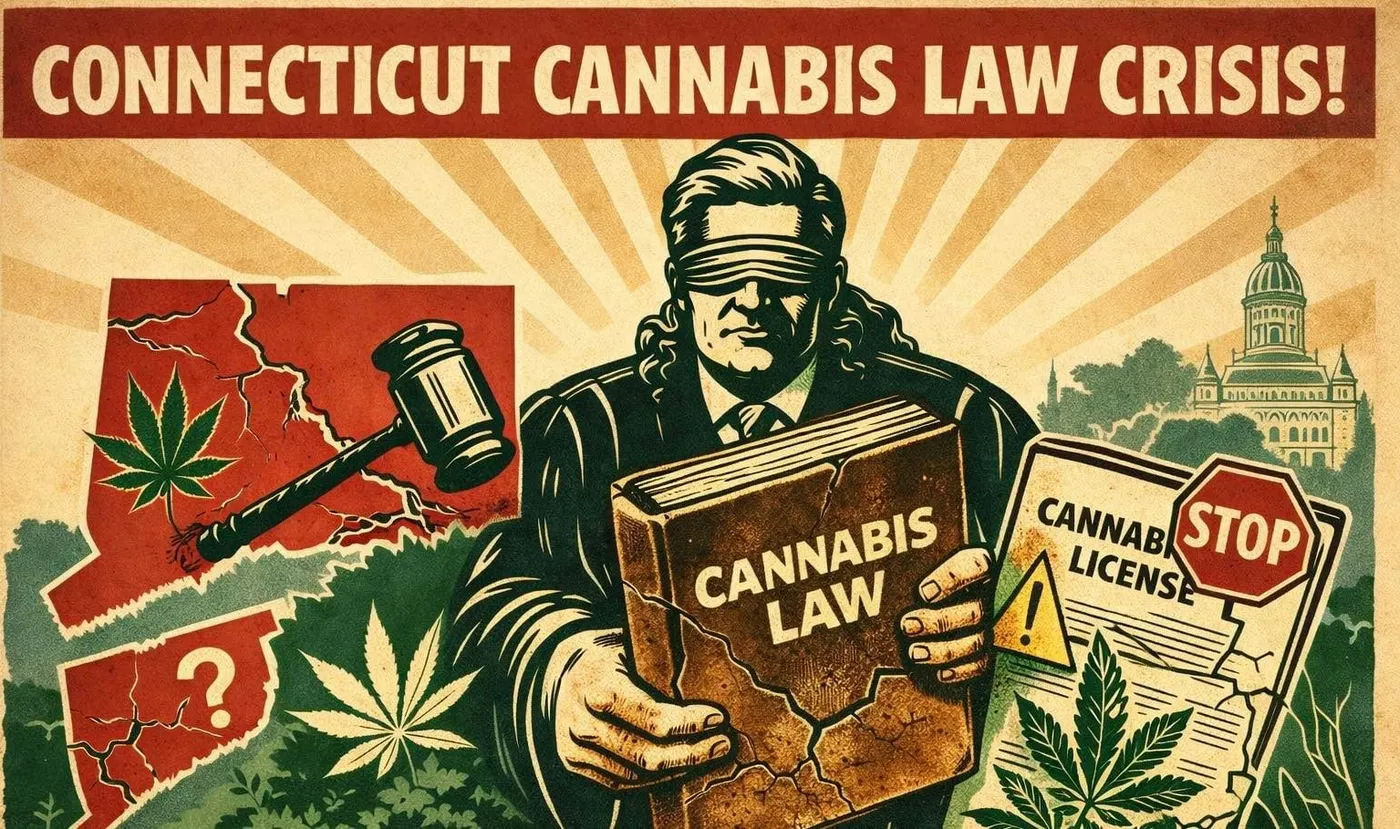
Connecticut’s Cannabis Law Has Massive Structural Cracks — Two Federal Cases Could Force CT To Rebuild Its Cannabis Law Entirely and Halt Enforcement
By CT CannaTimes - 12.24.2025
Connecticut’s cannabis framework is being tested in federal court — not over policy disagreements, but over whether the law itself works as written.
Two cases now pending in the U.S. District Court for Connecticut expose deep legal flaws in how the state regulates cannabis and hemp:
- Al Qadomi v. Lamont
- Smith v. Lamont
These cases do not argue about whether cannabis should be regulated.
They argue that Connecticut’s current statutes are internally contradictory, legally vague, and in some cases unenforceable.
What follows is a plain-language explanation of what the flaws are, why they matter, and what happens if the state loses either case.
The First Shock: Connecticut’s Cannabis Penalty Statute May Not Actually Criminalize Cannabis Sales
At the center of Al Qadomi v. Lamont is a rarely discussed statute:
Connecticut General Statutes § 21a-277(b)(1) — the law police and prosecutors use to charge unlicensed cannabis and hemp sellers.
As written, the statute says:
No person may sell any controlled substance other than
(A) a narcotic substance,
(B) a hallucinogenic substance, or
(C) cannabis.
In plain terms, the statute excludes cannabis from the prohibited conduct.
That creates a legal problem courts cannot ignore:
-
Criminal laws must clearly define what is illegal
-
Courts are not allowed to “fix” drafting mistakes after the fact
-
Ambiguous criminal statutes violate due-process protections
Why this matters:
If a court agrees with the plaintiffs, charges relying on this statute could be invalid, regardless of policy intent.
The Second Shock: Connecticut Passed Three Cannabis Laws in 2024 That Conflict With Each Other
In 2024, the legislature passed three separate cannabis/hemp laws:
- Public Act 24-76
- Public Act 24-95
- Public Act 24-115
All three:
-
Amended the same cannabis statutes
-
Were passed in the same session
-
Were signed on different dates
-
Do not cross-reference one another
Under Connecticut law, all amendments are presumed valid — even if they contradict each other.
The result is a regulatory maze where:
-
THC thresholds change depending on which act is read
-
Hemp products may be legal under one statute and illegal under another
-
Enforcement depends on interpretation, not clarity
Why this matters:
Courts routinely strike down laws that ordinary people cannot reasonably understand, especially when criminal penalties are involved.
The Third Shock: Connecticut Redefined Hemp in a Way Federal Law Does Not Allow
Federal law — the 2018 Farm Bill — defines hemp strictly as cannabis containing no more than 0.3% delta-9 THC.
Connecticut’s 2024 laws replaced that with “total THC”, counting delta-8, delta-10, and other compounds.
The Farm Bill explicitly prohibits states from redefining hemp.
Why this matters:
If federal law controls — and courts have consistently said it does — then:
-
Products legal under federal law cannot be criminalized by the state
-
State enforcement actions against federally legal hemp are vulnerable
-
Seizures, fines, and prosecutions may lack legal authority
The Fourth Shock: Connecticut May Be Blocking Interstate Hemp Commerce
The Farm Bill also protects the interstate transportation of hemp.
Connecticut’s laws and enforcement practices:
-
Restrict out-of-state hemp products
-
Favor in-state cannabis license holders
-
Prevent lawful interstate sales
That raises Dormant Commerce Clause issues — a constitutional doctrine that bars states from protecting local markets at the expense of interstate trade.
Why this matters:
If the court agrees, Connecticut cannot legally wall itself off from the national hemp market.
What Happens If the State Loses Al Qadomi v. Lamont
If Connecticut loses Al Qadomi, the effects would be immediate and disruptive:
Immediate consequences
- Enforcement of the 2024 cannabis/hemp laws would likely be halted
- Criminal prosecutions relying on those statutes would be stayed or dismissed
- Administrative penalties issued under those laws would lose footing
Short-term fallout
-
The state would be forced to stop hemp and cannabinoid enforcement
-
Police and regulators would lack clear authority
-
Courts would scrutinize past convictions and seizures
Long-term impact
-
The legislature would have to rewrite large sections of cannabis law
-
Statutory definitions would need to be rebuilt from scratch
-
Enforcement agencies would operate under tighter judicial oversight
This case attacks the legal foundation of enforcement, not just regulatory details.
What Happens If the State Loses Smith v. Lamont
Smith v. Lamont challenges a different part of Connecticut’s system: licensing.
The case alleges that Connecticut’s cannabis market is effectively closed:
-
Zero non-social-equity cultivator licenses issued
-
No general lotteries conducted
-
No viable path for non-equity or out-of-state applicants
Federal courts have now confirmed that the Dormant Commerce Clause applies to cannabis markets, even though cannabis remains federally illegal.
If the state loses Smith
-
Connecticut’s licensing scheme would be declared unconstitutional
-
The state would be forced to open cannabis markets
-
Residency-based and equity-only barriers would need revision
What Smith does not do
-
It does not invalidate criminal statutes
-
It does not halt enforcement overnight
Smith is a structural market case, not an enforcement case.
Why These Two Cases Together Matter
Taken together, these cases expose a broader reality:
- Al Qadomi asks whether Connecticut can legally enforce its cannabis laws at all
- Smith asks whether Connecticut can legally restrict who participates in the market
One challenges criminal authority. The other challenges economic control.
If Connecticut loses both, the state faces:
-
An enforcement system that cannot function
-
A licensing system that cannot stand
-
A forced legislative reset of cannabis law
The Bottom Line
These cases are not activist lawsuits. They are not ideological challenges. They are technical, statutory, and constitutional.
They ask one basic question:
Does Connecticut’s cannabis law actually work the way the state says it does?
Federal court may soon answer that question.
This story was originally published by Connecticut CannaTimes on Facebook on December 24, 2025 and was migrated to this website on October 16, 2026. The publication date above is the original date.
Related Stories

Smith v. Lamont Is Not Over: The Judge Ruled on Neither Side of the Constitutional Question
A federal judge dismissed the original complaint in Smith v. Lamont without prejudice. An amended complaint is on file, a Massachusetts grower is asking to join, and no court has ruled on whether Connecticut’s social equity licensing restrictions are constitutional.
Federal Licensing Challenge Continues as State Seeks Second Dismissal
A federal lawsuit challenging Connecticut’s cannabis social equity licensing system is moving into another round of litigation, with a new court conference scheduled for October 22.
Shut Out of Connecticut's Cannabis Industry? A Federal Ruling Shows Why Your Experience May Matter
A federal judge dismissed a constitutional challenge to Connecticut’s cannabis licensing system this week, but not because the court found the state’s social equity rules constitutional. The ruling instead identifies shortcomings in the plaintiff’s case and leaves the door open for an amended complaint. It also raises an important question: Are there cannabis entrepreneurs who
Cultivator Challenges Connecticut Licensing as Unconstitutional in New Federal Suit
Another lawsuit has landed in federal court this week — this time from a Connecticut resident arguing that the state’s cannabis licensing system is unconstitutional and discriminates against ordinary applicants.